AI Automation with Openclaw: The Complete Business Owner’s Guide

How ambitious SMEs can turn AI into a reliable growth engine

Executive summary — why you should read this

Every week I speak with business owners who feel overwhelmed by the growing list of tools, platforms, and tasks required just to keep their business running. Emails, enquiries, proposals, follow-ups, onboarding, reporting, internal coordination — the list never ends.

Most businesses are not short of ideas. They are short of time, capacity, and consistency.

This is where AI automation platforms like Openclaw are becoming transformational.

But here is the reality I see every day:
Many businesses try automation, set up a few workflows, and quietly abandon it within months. Not because the technology doesn’t work — but because the strategy behind it was missing.

This guide is different.

We are going to combine:

  • A practical step-by-step understanding of Openclaw
  • The real business strategy needed to make automation succeed
  • The governance, adoption, and ROI frameworks most guides ignore
  • Clear, actionable pro tips you can implement immediately

If you are an ambitious business owner who wants to build a reliable growth engine, this article will show you how AI automation can become one of the most valuable team members you will ever hire.

The reality facing modern SMEs

openclaw

Small and mid-sized businesses are expected to operate like large enterprises — but with a fraction of the resources.

You must:

  • Respond to enquiries instantly
  • Deliver excellent customer experience
  • Maintain marketing momentum
  • Keep operations efficient
  • Support your team
  • And still grow revenue

This pressure is not slowing down. It is accelerating.

Openclaw AI automation is no longer a “nice to have”. It is quickly becoming a competitive advantage.

Businesses that adopt it strategically will move faster, respond quicker, and scale more efficiently than competitors who rely solely on manual processes.

What Openclaw actually is — in simple terms

open claw

Think of Openclaw as a 24/7 digital operations assistant.

It connects your tools, listens for triggers, and performs tasks automatically.

It can:

  • Monitor emails, forms, and customer interactions
  • Update your CRM
  • Send responses and notifications
  • Create tasks and workflows
  • Generate reports
  • Route enquiries to the right people

In practical terms, it removes repetitive work from your team so they can focus on higher-value activities.

Many businesses save 10–20 hours per week once automation is implemented properly.

Before you start: the most important mindset shift

The biggest mistake businesses make is this:

They think automation is about technology.

It is not.

Openclaw automation is about business outcomes.

Technology is simply the tool.

Before touching any platform, we must answer one question:

What business problems are we trying to solve?

Step 1 — Define your automation success metrics

If you skip this step, automation will fail.

Before setting up Openclaw, define success clearly.

Your automation success framework

Choose metrics in three categories:

1) Efficiency metrics

  • Hours saved per week
  • Tasks automated per month
  • Reduction in manual work

2) Revenue metrics

  • Lead response speed
  • Conversion rate improvements
  • Sales cycle reduction

3) Customer experience metrics

  • Response time
  • Consistency of communication
  • Customer satisfaction

Pro tip

Start with a simple target:
Save 10 hours per week within 90 days.

This is achievable and measurable.

Step 2 — Choose high-ROI automation first

openclaw

Do not automate everything.

Start with high-impact workflows.

The top 5 automations every SME should start with

1) Lead capture and routing

When a website enquiry arrives:

  • Capture details
  • Send confirmation email
  • Add to CRM
  • Assign to salesperson
  • Create follow-up task

Instant response dramatically increases conversions.

2) Sales follow-up sequences

Most leads are lost due to slow or inconsistent follow-up.

Openclaw Automation can:

  • Send follow-up emails
  • Schedule reminders
  • Track responses

3) Customer onboarding

New clients need:

  • Welcome emails
  • Information requests
  • Task creation
  • Internal notifications

Automation ensures a professional, consistent experience.

4) Internal reporting

Weekly reports often consume hours.

Automation can:

  • Collect data
  • Generate summaries
  • Send dashboards to leadership.

5) Appointment and meeting workflows

Openclaw Automate confirmations, reminders, and follow-ups.

This reduces no-shows and improves customer experience.

Step 3 — Setting up Openclaw

openclaw

The technical setup is straightforward.

You will need:

  • A professional email account
  • Admin access to tools you want to connect
  • Basic understanding of workflows
  • About 30–60 minutes for initial setup

Account creation

  • Register your account
  • Verify email and enable security
  • Choose your plan
  • Complete your profile

Configure your AI assistant

Define:

  • Name and personality
  • Tone and language
  • Permissions and access levels

Pro tip

Start with restrictive permissions and expand gradually.

Step 4 — Integrate your business tools
openclaw

The power of Openclaw comes from integration.

Common integrations include:

  • Google Workspace
  • Slack or Teams
  • CRM platforms
  • Marketing tools
  • Calendar systems
  • Zapier and APIs

The goal is to create a single automation layer across your tech stack.

Step 5 — Build your first workflows

Automation works through triggers and actions.

Examples of triggers:

  • New email received
  • Form submission
  • Calendar booking
  • CRM update

Examples of actions:

  • Send notification
  • Create task
  • Update database
  • Send email response

Pro tip

Start with simple workflows and expand gradually.

The part most guides ignore: team adoption

Technology does not fail.
Adoption fails.

Your team must understand:

  • Why automation is being introduced
  • How it helps them
  • What tasks it will support

Internal launch strategy

  1. Announce the initiative clearly
  2. Explain the benefits
  3. Provide training
  4. Celebrate early wins

Position automation as a support tool, not a replacement.

Data privacy and security considerations

This is essential.

Before connecting systems, define:

  • What data can be accessed
  • Who has permission
  • How access is monitored

Establish:

  • Access controls
  • Audit trails
  • Permission reviews

This protects your business and your clients.

AI guardrails and risk management

openclaw

Openclaw AI must operate within clear boundaries.

Define:

  • When automation should escalate to humans
  • Approval processes for customer communications
  • Brand voice guidelines

Always include a human-in-the-loop for critical communication.

Your knowledge base strategy

AI is only as good as the knowledge it uses.

Prepare:

  • FAQs
  • Service descriptions
  • Processes
  • Templates
  • Documentation

Maintain and update this regularly.

This dramatically improves automation performance.

Measuring ROI and performance

Track Openclaw automation weekly and monthly.

Key metrics:

  • Hours saved
  • Tasks automated
  • Response time improvements
  • Conversion improvements
  • Cost savings

Pro tip

Create a simple automation dashboard and review monthly.

Your automation maturity roadmap

openclaw

Automation evolves over time.

Stage 1 — Starter

Basic workflows and quick wins.

Stage 2 — Operational

Cross-tool workflows.

Stage 3 — Scaled

Multi-department automation.

Stage 4 — Intelligent

AI insights and predictions.

Stage 5 — Autonomous

Advanced AI-driven operations.

Think long-term.

Department automation opportunities

Sales

  • Lead qualification
  • Follow-ups
  • Proposal generation

Marketing

  • Campaign reporting
  • Content workflows
  • Lead nurturing

Customer service

  • Enquiry routing
  • FAQ responses
  • Ticket creation

HR

  • Recruitment workflows
  • Onboarding processes

Finance

  • Invoice reminders
  • Reporting automation

Cost and ROI expectations

Most SMEs recover automation investment quickly.

Typical outcomes:

  • 10–20 hours saved weekly
  • Faster lead response
  • Improved customer experience
  • Reduced operational overhead

Automation often pays for itself within months.

Your first 90-day automation roadmap

Month 1

  • Define goals
  • Connect tools
  • Launch first workflows

Month 2

  • Expand automations
  • Train team
  • Track results

Month 3

  • Optimise workflows
  • Measure ROI
  • Plan next stage

Final thoughts

AI automation is not about replacing people.

It is about empowering your team to focus on meaningful work.

Businesses that adopt automation strategically will:

  • Move faster
  • Respond quicker
  • Scale more efficiently
  • Deliver better customer experiences

This is how you turn AI into a reliable growth engine.

Actionable pro tips recap

  1. Start with clear business goals.
  2. Automate high-ROI workflows first.
  3. Focus on team adoption.
  4. Protect data and set AI guardrails.
  5. Measure results and iterate.

If you have been considering automation, now is the time to start.

The businesses that act early will create a meaningful competitive advantage in the years ahead.

How AI Overviews Are Impacting SEO in Australia 2026

In 2026, Australia’s search landscape has transformed dramatically with Google AI Overviews (formerly Search Generative Experience or SGE) firmly established. Rolled out nationwide since late 2024, AI Overviews now appear in a significant portion of queries—reaching up to 39% in Australian searches by mid-2025, far exceeding global averages. This generative AI feature synthesises information from multiple sources to deliver direct, comprehensive answers at the top of results, often reducing the need for clicks. For Australian businesses, from Sydney SMEs to Melbourne retailers and Brisbane service providers, this shift challenges traditional SEO while opening new paths to visibility through Answer Engine Optimization (AEO) and entity-based authority. Studies show AI Overviews correlate with a 34.5% drop in click-through rates (CTR) for top organic positions, with some sites experiencing 20-60% traffic declines. Yet, those adapting see sustained or improved brand exposure, especially in local and informational searches where 46% of Australian queries carry local intent.

Australia’s AI Search Landscape in 2026

Search Engine Optimisation Strategy

Australia leads global AI search adoption, with users averaging 1.42 AI queries per person. Google AI Overviews dominate, appearing in 39% of searches—nearly triple the global rate—thanks to aggressive rollout starting October 2024. Features like follow-up questions transitioning to conversational AI Mode (powered by Gemini) are expanding, with full integration expected mid-2026 in tier-1 markets like Australia.

This evolution accelerates zero-click searches, where users get answers without visiting sites. Gartner forecasts a 25% drop in traditional search volume by year-end 2026, as AI chatbots and agents gain ground. For local businesses, this means hyper-local queries (e.g., “best plumber in Parramatta”) increasingly resolve via AI summaries citing authoritative sources. Informational and educational queries face the heaviest impact, while transactional and local pack results remain more resilient. Australian consumers value quick, trusted answers, boosting satisfaction but pressuring organic traffic. Businesses not adapting face 37% visibility declines, while AI-optimised ones maintain relevance across Google, ChatGPT, Perplexity, and emerging tools.

Key Impacts of AI Overviews on SEO

AI Overviews reshape SEO fundamentals in Australia.

Reduced Organic CTR and Traffic — Presence of AI Overviews lowers CTR by 34.5% for position 1 results, with zero-click rates surging. High-funnel informational content suffers most, as answers appear directly.

Shift to Citation and Visibility — Ranking in traditional blue links matters less than being cited in AI summaries. AI pulls from top organic results (80%+ overlap with top 3 preview links), rewarding strong E-E-A-T (Experience, Expertise, Authoritativeness, Trustworthiness).

Rise of AEO and GEO — Answer Engine Optimization (AEO) focuses on direct answers in AI responses, while Generative Engine Optimization (GEO) targets broader LLM visibility. Techniques include structured data, schema markup, and conversational content.

Local SEO Evolution — With high local intent, optimise for geo-specific entities, consistent NAP, reviews, and suburb-level content to appear in AI recommendations.

Measurement Challenges — Traditional metrics like clicks falter; track AI citations, brand mentions across platforms, and assisted conversions.

Opportunities in Adaptation — AI traffic often converts better due to higher intent. Businesses embracing AEO see quicker wins, with technical tweaks yielding citations in 3-8 weeks.

These changes demand a hybrid approach: maintain core SEO while prioritising AI-friendly content.

Strategies to Adapt Your SEO for AI Overviews in 2026

To thrive, Australian businesses must evolve.

Build Topical Authority — Create deep, interconnected content clusters demonstrating expertise. Use semantic variety, related entities, and first-hand insights over keyword density.

Optimise for Direct Answers — Structure content with clear topic sentences, FAQ schema, tables, and bullet points. Answer queries upfront in the first paragraph for easy extraction.

Enhance Technical Foundations — Ensure fast loading (local CDNs for Australian speeds), mobile optimisation, Core Web Vitals, and comprehensive schema (FAQ, HowTo, LocalBusiness).

Strengthen E-E-A-T Signals — Showcase author bios, citations, reviews, and original research. Consistent brand mentions across web build entity trust for AI citations.

Diversify Visibility — Optimise for multi-platform: Google AI Overviews, ChatGPT, Perplexity. Use PR for earned mentions that AI cross-references.

Monitor and Iterate — Track AI visibility tools for citations. Run prompt tests and adjust based on performance.

Start with audits and phased implementation—focus on high-impact pages first.

Overcoming Challenges for Australian Businesses

Traffic drops concern many, but adaptation mitigates risks. Budget for AI-specific tactics (adding 20-25% to SEO costs). Time-poor owners benefit from specialists handling AEO. Competition intensifies, but hyper-local focus differentiates. Partnering with experts ensures ethical, effective strategies without penalties.

Conclusion: Partner with Netstripes to Navigate AI-Driven SEO

In 2026, AI Overviews redefined SEO in Australia, shifting from click-focused rankings to authoritative citations and multi-platform visibility. Embracing AEO, strong E-E-A-T, and structured content positions businesses to maintain relevance, capture intent, and drive growth amid zero-click realities.

Netstripes, a leading Sydney-based digital marketing agency and web design company serving businesses across Australia, specialises in future-proof SEO including AI Overviews optimisation, AEO strategies, local SEO, technical enhancements, content planning, and data-driven tracking. Their expertise helps SMEs adapt seamlessly, secure citations in AI results, and achieve measurable visibility and leads in this evolving landscape.

Ready to transform your SEO strategy for the AI era? Get your free AI Visibility Audit and a tailored 2026 roadmap Contact Netstripes today for a complimentary AI visibility audit and tailored strategy—stay ahead in Australia’s competitive search environment in 2026.

The Blueprint Behind Google’s AI Overviews

What Google’s Discovery Engine Reveals About the Future of SEO and the Secrets Behind the 7 New Ranking Signals: Why This Matters Now

Search isn’t what it used to be. The classic model, ‘type a keyword and get ten blue links,’ is fading. In its place, we’re seeing a new paradigm emerge: a search experience powered by AI. 

At the heart of this shift is what Google Cloud Discovery Engine (also referred to as “Vertex AI Search”) reveals about how modern AI-led search works under the hood.

Thanks to insights shared by industry observers like Metehan Yeşilyurt, we now have a rare, tangible glimpse into the system powering AI-driven search: the underlying architecture, the ranking signals, chunking logic, and the signal‑fusion mechanism.

If you’re serious about staying visible and competitive in SEO over the next 2–5 years, this isn’t optional. It’s essential.

In this post, I break down what we know today, why it matters for businesses and marketers, and what you should do to align your content and digital strategy with this new reality.

Table of Contents
1. How Google’s AI Search Pipeline Seems to Work
2. What This Means in Practice: A New SEO Playbook
3. Why This Transparency from Google Matters
4. Potential Risks & What to Watch Out For
5. Conclusion: The AI‑First SEO Era Is Here, and It Demands Both Strategy & Content Craftsmanship

How Google’s AI Search Pipeline Seems to Work (Based on Discovery Engine)

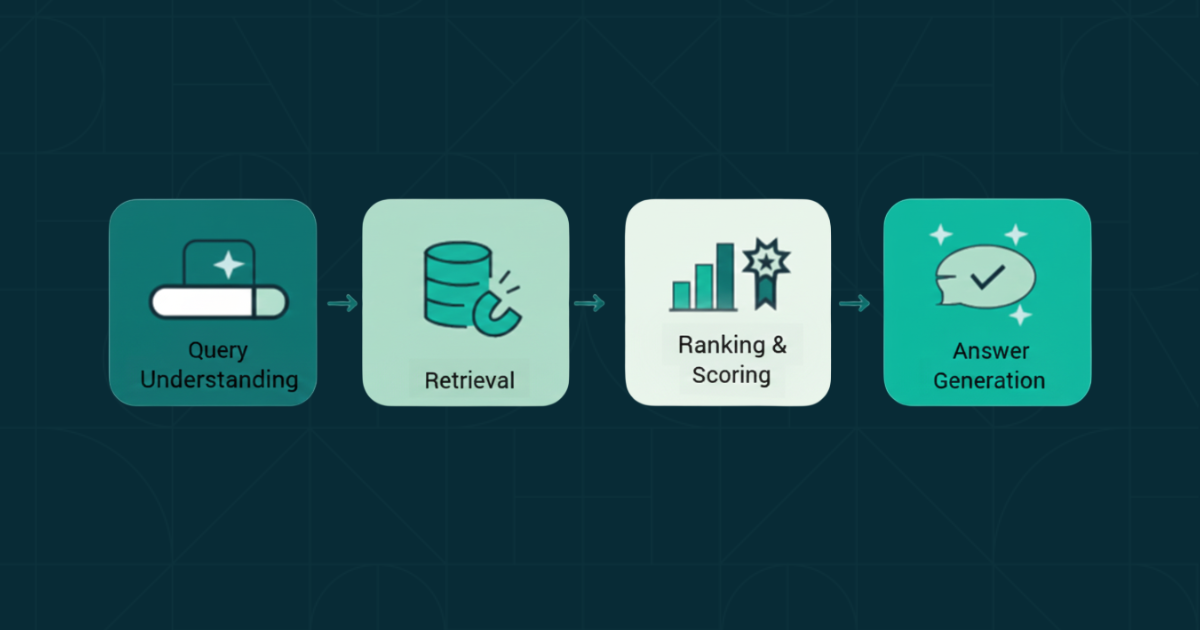
Metehan’s write‑up suggests Google isn’t winging this behind closed doors. There’s a structured, four‑stage pipeline powering its AI search and ranking behaviours. Here’s how it appears to function:

StageWhat HappensWhy It Matters to You
Prepare / Query UnderstandingUser queries are normalised, contextualised, expanded — synonyms, autocomplete options, query reformulation, etc.Keywords alone no longer cut it. Your content must cover the broader semantic field, including related terms, alternative phrasing, and evolving lingo.
Retrieve / Document Selection & ChunkingSystem pulls candidate documents and breaks them into chunks — roughly ~500 tokens each (≈ 350–400 words), preserving heading context if configured.Your content must be structured in modular, self‑contained “chunks” (with H2/H3s, clear sub‑sections, concise paragraphs) to survive chunk‑level retrieval.
Signal / Ranking & ScoringRetrieved chunks are evaluated based on up to 7 ranking signals (see below).SEO today is multidimensional — from semantic relevance to engagement and freshness. You need a holistic content strategy.
Serve / Answer GenerationTop‑scoring chunks are fed into LLMs (e.g. Gemini) for synthesis into user‑facing responses — summaries, conversational answers, AI‑Overviews.The best content doesn’t just rank — it gets cited, summarised, and shown as the “answer.” That boosts brand authority even in zero‑click contexts.

This is far more than “SEO with AI sprinkling.” It’s a fundamental shift in how content is discovered, evaluated and delivered.


The 7 Signals Powering AI‑Mode Ranking (and What You Should Do About Them)

According to the publicly exposed “Signal Viewer” in Discovery Engine (as highlighted by Metehan), here are the seven key signals — along with what they mean for content strategy.

SignalWhat It MeasuresStrategic Implication
1. Base RankingThe baseline relevance score (similar to old‑school SEO ranking)Maintain strong technical SEO: fast site, crawlable pages, robust site structure — core foundation matters.
2. Embedding‑Based Semantic Similarity (“Gecko Score”)Vector‑based semantic proximity between query intent and contentContent must be semantically deep — cover related topics, synonyms, context. It’s not just about hitting keywords but matching concepts.
3. Cross‑Attention Semantic Relevance (“Jetstream Score”)Contextual understanding: negation, nuance, relationships — handles “not”, “without”, “vs”, comparative queries better than embeddings aloneWrite clearly. Anticipate intent. Explain what is and isn’t. Address comparisons directly (“pros vs cons”, “alternatives”, “why choose X over Y”).
4. Traditional Keyword Matching (e.g. BM25)Classic keyword-to-content matchingKeywords remain relevant but only as one of several signals. Don’t abandon them, but also, don’t rely solely on them.
5. Engagement & Predicted User Interaction (PCTR / Personalised CTR)Likelihood of click or engagement based on historical & predicted behaviourOptimise for real users: readable content, strong UX, clear value. Engagement signals matter more than ever.
6. Freshness / RecencyNew or recently updated content is often given priority (especially on time‑sensitive topics)Regularly update content. For evergreen topics, include a “last reviewed/updated” timestamp. For evolving topics (e.g. laws, tech, trends), prioritise freshness.
7. Boost/Bury (Manual or Rule‑Based Overrides)Allows overrides based on quality, brand authority, and manual rules — important for enterprise or trusted‑source preferenceEstablish authority & trust: About page, credentials, reviews, authoritative references. Treat your site as a brand, not just a content factory.

What This Means in Practice: A New SEO Playbook

1. Structure Content in Modular Chunks

  • Use clear headings (H2/H3) not just for readability, but for AI retrieval logic.
  • Keep each “chunk” around 300–400 words if possible, self‑contained and coherent.
  • Use bullet lists, short paragraphs, tables, and clear formatting to make extraction easier for AI.

In short: think like a content engineer, not a blogger.

2. Fill the Semantic Field, Not Just Keywords

  • Expand topics broadly: cover synonyms, related concepts, comparisons, FAQs.
  • Use natural language context: imagine how different users might ask the same question differently.
  • Build content clusters: core page + multiple supportive pages exploring subtopics, variations, and edge-cases.

3. Write for Real Humans, But Optimise for AI Logic

  • Use clear language. Avoid unnecessarily complex sentences or over‑industry jargon.
  • When addressing comparisons or negations (e.g. “vs”, “without”, “not”), do so explicitly. AI’s semantic models (like Jetstream) are more sensitive to this than traditional keyword matching.
  • Provide evidence, data, sources or citations whenever possible, as this helps build trust and enables AI to verify credibility.

4. Keep Content Fresh, Especially on Time‑Sensitive Topics

  • Regularly review and update content (especially for legal, regulatory, tech, and trending topics).
  • Add “last updated” timestamps to pages — better for freshness signal and for user trust.
  • Consider supplementary follow-up posts that dive into developments, context shifts, or related questions (ideal for an AI follow‑up-answer format).

5. Build Real Engagement & Brand Trust Signals

  • Encourage genuine user engagement (comments, shares, dwell time), which feed into predicted‑engagement signals.
  • Include brand, author credentials, about pages, and trust indicators (testimonials, case studies, social proof).
  • For enterprise‑level clients, structured data (schema, entity markup) is more important than ever.

Why This Transparency from Google Matters

Until recently, much of search optimisation felt like guesswork. We observed correlations, tracked rankings, made hypotheses. But with the exposure of Discovery Engine’s inner workings, much of that guesswork becomes strategy.

Here’s why this matters big time for you as a business leader or marketing manager:

  • You no longer optimise blindly

You can prioritise structural quality, semantic depth, engagement, and freshness with real reasoning behind it.

  • It levels the playing field for good content

Smaller sites with well‑crafted content stand a chance against legacy domain authority if they align with these signals.

  • It future‑proofs your content

SEO isn’t just about keywords or links anymore — it’s about building content assets that endure, adapt, and stay relevant as AI search grows.

  • It creates a new value paradigm

Visibility may no longer be clicks but citations, trust, and brand presence in AI‑driven responses. That’s a branding and authority play — especially valuable for SMEs and niche enterprises.


Potential Risks & What to Watch Out For

No system is perfect. Even with these insights, there are uncertainties and risks we need to consider:

  • The weighting of signals may change. What’s true today may evolve. Over‑optimising for one signal could be risky if Google shifts priorities.
  • Niche or contrarian content could struggle. Semantic similarity + consensus bias may mean unique or dissenting perspectives are less likely to surface.
  • Over‑engineering vs. human‑centrism. There’s a risk of creating content that reads well to AI — but poorly to humans. Always keep user experience front and centre.
  • Scale & resource challenge for SMEs. Structuring content as modular chunks, updating frequently, managing engagement — good content at this level takes discipline and resources.

Conclusion: The AI‑First SEO Era Is Here, and It Demands Both Strategy & Content Craftsmanship

The Discovery Engine revelations show us that Google’s AI search logic isn’t magic; it’s engineering. It’s transparent. It’s structured.

For business owners and marketing leaders, this represents a once‑in‑a‑generation opportunity. If you adopt a content strategy built on semantic clarity, structured architecture, engagement, freshness and brand trust, you don’t just adapt to the future of search. You lead it.

At NetStripes, that’s exactly the kind of forward‑leaning, AI‑aware SEO strategy we’re championing for Aussie SMEs.

To learn more about how we can help get your business’s seo on track, book a free consultation with our SEO specialist here.

Digital Trends 2026: What Every Small Business Owner Should Know

Featuring insights from Dinesh De Silva, CEO, NetStripes

From smarter AI tools to new ways of connecting with customers, technology is reshaping how small and medium businesses grow, market, and operate. The good news? You don’t need a massive budget to stay ahead of the digital trends 2026.

Most of these innovations that are reshaping the business world in 2026 are accessible and affordable, enabling small and medium-sized businesses to harness enterprise-level technology.

Here’s our guide to the 10 Digital Trends that matter most in 2026 and how you can apply them to gain an edge.

1. AI Assistants & Everyday Automation

Digital Trends 2026 AI

AI has officially become part of everyday business. By 2026, smart assistants will be doing much more than writing text; they’ll be managing schedules, qualifying leads, replying to emails, and even running parts of your business while you sleep.

Tools like ChatGPT Teams, Fyxer AI, HubSpot AI, n8n, and Zapier Agents are making automation easier and more affordable than ever.

Pro tip: Choose one repetitive task, such as appointment scheduling or customer follow-ups, and automate it. Once you see the time savings, you’ll be hooked.

2. Smarter Dashboards & Connected Tools

Digital Trends 2026 - dashboards

If you’re tired of juggling spreadsheets and tabs, you’ll love this trend. In 2026, more small businesses are connecting their website, socials, email, and ad platforms into one simple dashboard.

Tools like Looker Studio, Metricool, or Databox show you what’s working in real time, so you can make quick, confident decisions without having to refer to multiple sheets or tabs.

Pro tip: Start by linking your Google Analytics, Meta Ads, and CRM data into one dashboard. You’ll spot insights you’ve never seen before.

3. Generative AI: Fast, Creative, Affordable

Digital Trends 2026 - Gen AI

Generative AI is changing the way brands create ads, blogs, videos, and even customer testimonials. You no longer need a big marketing team to create great content. 

With Canva Magic Studio, Adobe Firefly, and ChatGPT, you can design visuals, write posts, and draft videos in minutes, all while keeping your unique style intact.

The most important thing is to keep your brand’s personality clear. AI can do much of the work, but your personal touch still makes content feel authentic and relatable.

Pro tip: Use AI for the first draft, then polish it with your personal touch. You’ll create faster and still sound like you.

4. Personalisation That Feels Human

Digital Trends 2026 - brands personalization

Customers expect more than generic messages. In 2026, personalisation means delivering the right message at the right time, without needing a big data team.

Nowadays, smart CRMs, social ad platforms, and eCommerce tools analyse real-time data to recommend products, predict needs, and deliver the right message at the right time.

AI-driven platforms like Mailchimp, ActiveCampaign, Shopify, and Meta Ads make this simple by analysing customer behaviour and suggesting what to say next.

Action tip: Try one personalised campaign, such as product recommendations or location-based offers. Measure how much better it performs than your usual emails.

5. Human Brands Win

Digital Trends 2026 - human brands

In a world that is dominated by automation and AI, authenticity has become your biggest competitive edge. 

Online consumers still crave a ‘’human touch’’ and want to know who they’re buying from. Your story, your values, and your passion all matter when it comes to selling your products or services.

By showing up as you, you create trust, relatability, and loyalty that no algorithm can replicate.

Pro tip: Create short videos or posts that share the story behind your business; why you started, what drives you, or even a glimpse of your team in action. Let your audience see the real faces and emotions behind the brand.

“Your greatest strength in the age of AI is still you.”

6. Strategy Before Software

Digital Trends 2026 - strategy before software

Before jumping into new tools or digital trends 2026, start with a clear digital strategy. Too many businesses are pouring money into websites, ads, or AI subscriptions without a clear direction and then end up wondering why the results fall short.

A strong digital strategy gives every action meaning. It connects your goals, audience, and resources so each decision moves your business forward with a purpose.

That’s where tools like netStripes’ Xell.ai come in handy, helping you refine your business strategy by identifying your strengths and uncovering opportunities before you invest.

Pro tip: Define your target audience, goals, and how you’ll measure success. When your strategy is prioritised, every tool you add works harder for you.

7. Customer Experience Is the New Marketing

Digital Trends 2026  - customer experience in marketing

Every click, email, and interaction shapes how customers perceive your business. In today’s hyper-connected world, marketing isn’t just about what you say; it’s about how people feel every time they engage with you.

The businesses winning in digital trends 2026 are those using digital tools to deliver seamless, stress-free experiences. That means faster responses, easier bookings, consistent communication, and proactive support, the kind that makes customers say, “That was simple.”

When your customer experience is smooth and reliable, it becomes your most powerful marketing tool, driving word-of-mouth, loyalty, and repeat sales automatically.

Action tip: Map your customer journey. Look for one area that causes friction (like response time or booking ease) and fix it with automation or AI.

Digital Trends 2026 - Conversational & Visual Search

People are no longer typing keywords, they’re asking questions and showing pictures.
AI-driven search tools like ChatGPT Search and Google’s AI Overviews are changing how customers find businesses.

Now, people ask questions like ‘Where can I find a family accountant near Parramatta?’ and AI tools respond with one or two top answers instead of a long list of links.

To stay discoverable, businesses need to optimise content for conversational and visual queries. That means writing in natural language, using structured data, and including clear visuals or videos where possible.

Pro tip: Update your website FAQ and blog sections to answer common customer questions directly. This format is more likely to be picked up by AI search engines and featured in conversational results.

9. Build Your Own Audience

Digital Trends 2026 - audience building

Social media is powerful, but it’s rented space. Algorithms shift, reach drops, and one policy change can make your audience disappear overnight.

The most successful business owners in 2026 are focusing on building their own micro-communities.

By building your own audience through newsletters, private groups, or membership content, you gain control over how and when you connect with customers. It’s not just about followers anymore, it’s about relationships that last beyond the feed.

When you create a direct line of communication, you can share valuable insights, announce new offers, and build loyalty without depending on social media platforms to do the work.

Action tip: Turn your best social content into a monthly email or private online group. It’s your space, not the algorithm’s.

10. Keep Learning, Always

Digital Trends 2026-Learning

Technology won’t slow down, and neither should you. The businesses that thrive in 2026 aren’t necessarily the biggest; they’re the ones that stay curious and keep adapting.

When learning becomes part of your company culture, innovation follows. Whether it’s exploring new digital tools, attending webinars, or encouraging your team to upskill, continuous learning keeps your business agile, competitive, and future-ready.

Action tip: Block an hour or two in your calendar each month to explore a new tool or digital trends 2026 on your own or as a team. Curiosity compounds over time.

Where to Begin

  1. Automate one task with AI.
  2. Connect your digital tools into a single view.
  3. Personalise your customer experience.
  4. Share your story online.
  5. Keep learning and improving every month.

You don’t need to do it all at once, just start slow, stay curious, and focus on progress, not perfection.

Digital Trends 2026 - Dinesh De Silva netstripes

Conclusion

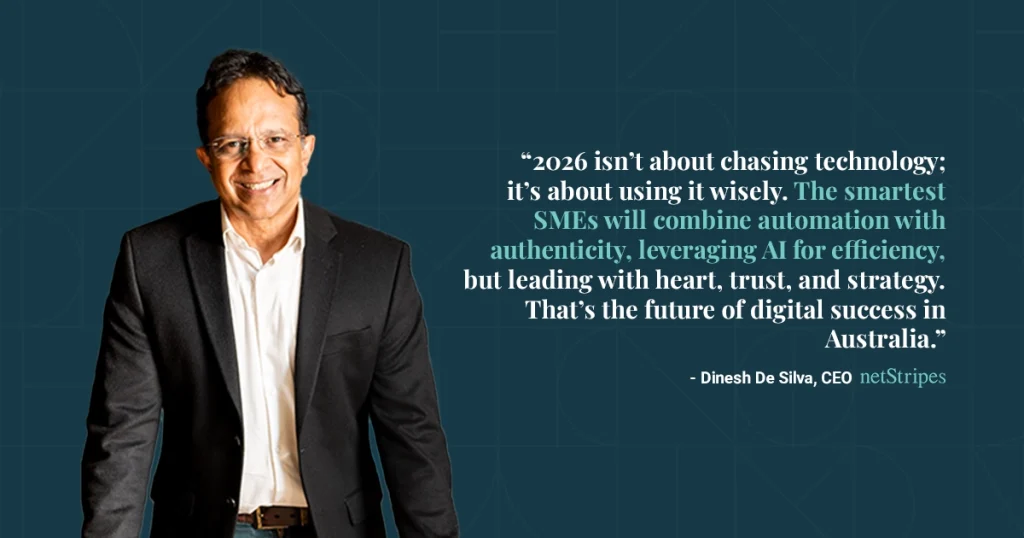
2026 isn’t about chasing technology for technology’s sake.  It’s about using it wisely to save time, serve customers better, and grow your business with confidence with these top digital trends.

At netStripes, we believe innovation should always be practical, affordable, and human-centred, empowering business owners to do more, with less, while staying true to who they are.

To find out more about how you can apply these digital trends to your business, book a FREE digital advisory session with our digital strategists.