Real Estate SEO Strategies For Business in Australia 2027

Before a buyer ever steps foot in an open home, they start on Google. In a competitive 2027 market, if agents aren’t found there, they aren’t considered. Right now in 2027, the Australian property market is still moving forward, even with all the talk about interest rates and affordability. Forecasts show national house prices could climb around 7-8% this year, with places like Perth and Brisbane leading the way. It’s a competitive space – buyers and sellers are searching online first, often starting with Google to check suburb prices, recent sales, or local agents.

If your agency isn’t showing up high in those searches, you’re missing out on people who are ready to buy, sell, or rent. Real estate SEO Strategies to Grow Your Real Estate Business, which helps you get found naturally, brings in better-quality leads, and cuts down on spending big on ads or portal fees. The best part? Once you’re ranking well, the traffic keeps coming without constant extra costs.

In this guide, We walk you through practical steps that actually work for Australian real estate agents and agencies right now. These are based on what’s ranking today and what Google cares about after the latest updates.

Why Focusing on SEO Makes Sense This Year

People don’t just browse – they search with real intent. Queries like “houses for sale in [suburb]” or “best real estate agent near me Brisbane” happen every day. Local searches are huge, and with more folks using voice search on phones, natural questions like “what’s the property market like in Perth right now?” are common.

Google keeps rewarding sites that feel helpful and trustworthy – showing real local knowledge, fresh info, and proof you’ve been in the trenches. Agencies posting genuine suburb updates, sold prices, and honest advice do much better than those with generic pages.

1. Get Your Keyword Research Spot-On for Local Searches

Don’t chase broad terms like “real estate agent” – they’re too crowded. Instead, dig into what people in your area are actually typing.

Use free tools like Google Keyword Planner or paid ones like Ahrefs/SEMrush to find:

  • Specific buyer searches: “3 bedroom house for sale Toorak VIC”, “investment properties Gold Coast under 600k”
  • Seller questions: “how to sell my home quickly in Adelaide 2027”, “current house prices Fremantle”
  • Everyday local ones: “real estate agent South Yarra reviews”, “auction results Byron Bay this weekend”

Look for longer phrases (long-tail keywords) with decent searches but less competition. Add in Aussie ways of asking things, since voice search loves conversational language.

Group them into topics. Build a main guide like “Selling Your Home in Melbourne This Year” and link to supporting posts about staging tips, pricing realistically, or what to expect at auction.

Check and update your list every few months – things shift with rates, new developments, or migration patterns.

2. Make Every Page on Your Site Work Harder

Once you’ve got your keywords, put them in naturally where they belong.

  • Page titles and meta descriptions: Start with the location and main service, e.g., “Real Estate Agents in Brighton VIC | Sell or Buy with Confidence”
  • Headings: Use clear H1 for the main topic, H2/H3 for sections like recent sales, school zones, or buyer tips.
  • Property listings: Write detailed descriptions that include key details (bedrooms, land size, features). Add good photos with alt text like “modern kitchen in 4-bed family home Brighton”.
  • Link internally: Connect related pages so visitors (and Google) can easily move around your site.

Add video tours or short suburb walkthroughs – people stay longer when they see real visuals.

3. Fix the Technical Basics So Google Loves Your Site

Real Estate SEO Strategies

A slow or clunky site loses people fast – and Google notices.

Focus on:

  • Speed: Get pages loading in under 3 seconds (compress images, use caching, maybe a CDN).
  • Mobile-friendly: Most searches happen on phones, so test everything looks good and works smoothly.
  • Structured data: Add schema for your business (address, phone, reviews) and for listings to help rich results show up.
  • Clean URLs: Something like yoursite.com/homes-for-sale-perth-north instead of random numbers.

Run a quick check with Google Search Console to spot broken links or other easy fixes.

4. Own Local Search – This Is Where Most Leads Come From

For real estate, being strong locally is everything.

  • Google Business Profile: Claim it, fill out every section completely (hours, services, areas you cover). Add fresh photos of recent sales, your team, and the office. Post weekly about new listings, market snippets, or open homes. Reply to every review quickly – good ones build trust fast.
  • Get listed consistently: Make sure your name, address, and phone number (NAP) match exactly on sites like Yellow Pages, TrueLocal, Localsearch, and the big portals.
  • Suburb-specific pages: Create one solid page per area you work in. Include local stats (recent sold prices, average days on market), info on schools/transport/cafes, and real client stories. This helps you show up in the map pack and regular results.

5. Write Content People Actually Read and Trust

Google wants content that shows you know your stuff – not just filler.

Try:

  • Monthly suburb reports: “What’s Happening in Brisbane Property Right Now – Prices, Sales, Trends”
  • Helpful guides: “First Home Buyer Steps in Sydney 2027”, “How to Get Your Home Ready for Auction in Perth”
  • Video explainers or quick tips embedded on pages

Show your experience – add team bios with real sales history and qualifications. Update old posts when things change (like new interest rate moves).

6. Build Links the Right Way

Good links from relevant sites still help a lot.

Ways to earn them:

  • Team up with local brokers, solicitors, or builders for joint content or shout-outs.
  • Get involved in community stuff – sponsor a local event and get mentioned naturally.
  • Share useful original info (like a suburb comparison tool or growth report) that others link to.

Stick to quality Australian sites – skip spammy directories.

7. Keep an Eye on What’s Working

Track with Google Analytics and Search Console:

  • How much organic traffic and actual enquiries you’re getting
  • Which keywords are climbing
  • How often you appear in local map results

Look monthly and tweak as needed. Small steady improvements add up to big lead growth over time.

Things to Steer Clear Of

Skip keyword stuffing, buying dodgy links, or letting your Google profile sit untouched. Don’t publish thin or copied content – it hurts more than helps these days.

Wrapping It Up

Getting SEO right lets you attract serious buyers and sellers straight to your door without always paying for clicks. In a market that’s still growing (especially in spots like Perth, Brisbane, and Adelaide), being visible locally builds your reputation and fills your pipeline with better leads.

Start small: tidy up your Google Business Profile today, pick one suburb to build a strong page for, and check your site’s speed. Consistent effort pays off.

At netStripes, we help real estate businesses across Australia put these exact steps into action – from site tweaks and local optimisation to content that ranks and converts. We keep it straightforward and focused on real results for your agency.

Want to see how this could work for your specific areas and get more direct enquiries? Book a free, no-pressure chat to see how we can help you dominate your local market. We’ll review your current setup and map out quick wins to help you stand out in 2027.


The 2026 Digital Playbook for Sydney SMEs: Outpace Local Competitors and Grow

In Sydney small and medium-sized enterprises (SMEs) face intense local competition amid rising costs, regulatory changes, and evolving consumer expectations. As 2026 unfolds, digital transformation is no longer optional—it’s the key differentiator. Australian SMEs adopting AI-driven tools, hyper-personalisation, and data-led marketing are achieving stronger growth and customer loyalty. With Sydney’s tech-savvy market demanding seamless online experiences, a well-crafted digital strategy enables local businesses to capture more market share efficiently.

Sydney’s SME Landscape in 2026

Sydney SMEs, which form the backbone of New South Wales’ economy, contend with persistent challenges like inflation, labour shortages, and compliance pressures. Economic forecasts highlight wage growth supporting consumer spending, yet businesses must navigate supply chain disruptions and stricter regulations in retail and services.

Opportunities emerge from the city’s innovation ecosystem, including access to AI technologies and digital grants. Consumers in areas like the CBD, Eastern Suburbs, and Inner West increasingly expect personalised, mobile-first interactions. Over 70% of searches are mobile-driven, and AI adoption is accelerating, with many SMEs using tools for efficiency. Those prioritising digital strategies see higher visibility and conversions, turning local advantages into sustained leads.

Key Digital Trends Shaping 2026 for Sydney SMEs

2026 brings transformative trends that Sydney SMEs must embrace to stay ahead.

1. AI Integration and Automation dominate, with generative AI enabling content creation, customer service chatbots, and predictive analytics. SMEs use AI for hyper-personalised campaigns, boosting engagement significantly.

2. Hyper-Personalisation is essential. Data analytics allow geo-targeted promotions for Sydney suburbs, from Bondi beachgoers to Parramatta professionals, improving conversion rates.

3. Short-Form Video and Social Commerce thrive on platforms like Instagram Reels and TikTok. Video content, expected to comprise most traffic, showcases authentic local stories effectively.

4. Answer Engine Optimisation (AEO) evolves SEO. Focus on being cited in AI overviews through structured data and authoritative content.

5. Omnichannel and Privacy-First Approaches build trust. Integrate online and in-store experiences while prioritising data security amid rising cyber threats.

6. Sustainability and Authentic Marketing resonate with eco-conscious Sydneysiders. Highlight green practices to differentiate your brand.

These trends, driven by AI and consumer shifts, reward agile SMEs over larger competitors.

Core Elements of a Winning Digital Strategy

Build a robust strategy around three pillars: clear planning, strong online presence, and targeted promotion.

1. Start with a digital maturity audit to assess your website, social channels, and analytics. Set SMART goals, such as increasing qualified leads by 30% in the next quarter.

2. Develop a refined business model aligned with digital goals. Craft high-impact websites that embody your brand, build trust, and convert visitors.

3. Leverage data-driven advertising including Google Ads, SEO, social media (Facebook, Instagram, LinkedIn), and retargeting. AI tools optimise campaigns for better ROI.

4. Incorporate cybersecurity and ongoing support to protect growth. Monthly metric reviews ensure continuous improvement.

Step-by-Step Guide to Implementation

  1. Assess and Plan — Conduct a free audit using tools like Google Analytics. Identify gaps in mobile optimisation and local SEO.
  2. Define Your Audience — Create personas based on Sydney demographics. Target high-value suburbs with tailored messaging.
  3. Build Foundations — Launch or redesign a mobile-responsive website optimised for speed and conversions.
  4. Execute Channels — Roll out SEO for organic traffic, paid ads for quick wins, and social content for engagement.
  5. Integrate AI — Pilot tools for personalisation, automation, and analytics. Scale successful elements.
  6. Measure and Optimise — Track KPIs like cost per lead and ROI. Adjust monthly based on performance data.

Allocate 7-10% of revenue to digital efforts, focusing on high-ROI activities. Partner with experts for efficient execution.

Overcoming Common Barriers

Time-poor owners often delay digital adoption. Outsourcing to specialists addresses this, providing tailored, cost-effective solutions. Sydney’s ecosystem offers accessible support to implement hyper-local strategies that competitors miss.

Budget constraints are mitigated by starting small—focus on one channel, measure results, then expand.

Conclusion: Partner with Netstripes for Lasting Success

2026 presents Sydney SMEs with a clear choice: lead digitally or risk falling behind. By embracing AI, personalisation, and strategic execution, you can outpace local competitors, drive sustainable growth, and build resilience.

Netstripes, a leading Sydney-based digital marketing agency and web design company, specialises in helping SMEs like yours. With expertise in digital strategy advisory, high-impact website design, SEO, Google Ads, social media marketing, and data-driven advertising, Netstripes refines your business model, creates world-class online presence, and delivers measurable results. Their holistic approach empowers time-poor owners to compete effectively and achieve goals.

Would you be ready to craft your winning digital strategy? You can contact us today for a complimentary consultation and take the first step towards dominating your local market in 2026.

How to Make Social Content That Sells (Without Feeling Like Ads)

If social media has ever made you feel like you have to choose between “being salesy” and “getting results”, you’re not alone.

Most businesses either:

  • post safe, polished content that gets a few likes but no enquiries, or
  • post hard-sell promos that feel like ads… and get ignored.

The sweet spot is different. Social content sells best when it feels like a real person helping, not a brand broadcasting.
And that’s why the biggest lever for 2026 isn’t a fancy camera, a complicated content calendar, or the latest trend audio.

It’s this: a genuine person, speaking naturally, on camera.

Not acting. Not reading. Not performing. Just being clear, human, and helpful. Let’s break down how to build social content that drives enquiries – without feeling like an ad.

(1) Why “real person on camera” works (when everything else feels the same)

Your audience is drowning in content. They scroll past businesses that look polished but forgettable, because it feels like “marketing”. What stops the scroll is human.

A real person on camera does a few things instantly:

  • Builds trust faster than text or graphics ever can
  • Makes your business feel legitimate and accessible
  • Answers the unspoken question: “Who am I dealing with?”
  • Helps people picture what it’s like to work with you

The goal: sell without sounding like you’re selling

Content that sells is usually doing one of these jobs:

  1. It removes doubt (addresses fears, objections, confusion)
  2. It shows proof (results, happy customers, real work)
  3. It makes the next step feel easy (what happens if I enquire?)

If your content hits those three, it will drive enquiries – even if you never say “Buy now”.

A simple script you can copy

If you’re not sure what to say on camera, try this:

  • Line 1 (hook): “Quick one – if you’re [situation], don’t do anything until you check this.”
  • Line 2 (the issue): “The most common mistake we see is…”
  • Line 3 (the fix): “What you want instead is…”
  • Line 4 (proof): “We had a client recently who…” (one sentence)
  • Line 5 (next step): “If you want, message us and we’ll tell you what we’d do in your situation.”

That’s it. That’s a selling video that doesn’t feel like an ad.

(2) What to post (so you don’t run out of ideas)

Most businesses don’t need more content ideas. They need a repeatable structure. Use these five “content pillars” and you’ll never feel stuck:

a) Proof

  • Before/after
  • Results and outcomes (even simple ones)
  • Testimonials (spoken by you or shown on screen)
  • “What we delivered and why it worked”
  • “A quick win we fixed this week”

If you only post one type, post proof. Proof is what turns attention into enquiries.

b) Education

  • Costs and pricing factors (even if you give ranges)
  • What to expect in the process
  • Mistakes to avoid
  • “How to choose the right ___”
  • “Is ___ worth it?”

This content sells because it reduces uncertainty.

c) Process

  • “Here’s what happens behind the scenes!”
  • “How we do it differently”
  • Your checklist or standards
  • A day on the job / in the office
  • Quality checks

This is powerful because it signals competence without bragging.

d) Authority

  • Your experience, training, certifications
  • Your tools and methods (explained simply)
  • Industry updates (in plain language)
  • “What’s changed this year in ___”

Authority content is best when it’s calm, not loud. Think “trusted guide”.

e) Offer

  • Seasonal relevance (EOFY, summer prep, etc.)
  • A simple call to action: “Message us”, “Book a call”, “Get a quote”

The trick: keep offers as invites, not pressure.

(3) How to make on-camera content feel authentic

This is where most people freeze. So here’s the truth:
You don’t need to “perform”. You need a setup that makes it easy to talk like a normal person.

Make it feel like a conversation

Instead of talking to “the internet”, talk to one person:

  • a customer you like
  • someone who asks you questions all the time
  • your best client type

A small change like that makes your tone instantly more natural.

Film in your normal environment

An office, workshop, job site, car, store – anywhere that feels real.
A plain background with a ring light can work, but “real” often performs better because it feels believable.

Keep the take, keep the humanity

A tiny stumble, a laugh, a breath – it’s fine. Sometimes it’s better. Perfection can look like an ad. Real is what people trust.

(4) How to turn views into enquiries (without being pushy)

People often watch and agree… then do nothing. That’s normal. You just need a clear next step.

Make the CTA feel like help

Instead of: “Buy now”
Try:

  • “Message us and we’ll point you in the right direction.”
  • “If you want a quick quote, send your details and we’ll tell you what’s realistic.”
  • “Not sure if this is right for you? Ask us – we’ll be honest.”

This works because it feels safe.

(5) Consistency is what makes everything else work

Great content doesn’t convert if people only see it once.

Most enquiries come after someone has watched your content multiple times — often without liking, commenting, or following. Consistent posting is what turns you from “someone I saw once” into “the business I trust”.

Consistency does three important things:

  • It builds familiarity (you start to feel known)
  • It compounds trust over time
  • It keeps you visible when someone is finally ready to enquire

You don’t need to post every day. You just need a realistic rhythm you can stick to. One or two clear, helpful videos per week is enough if you stay consistent.

The goal isn’t intensity or perfection — it’s showing up regularly, sounding human, and letting the results stack over time.

Final Thoughts

The businesses that win on social aren’t the ones with the fanciest graphics. They’re the ones that feel real.
A genuine person on camera – calmly explaining, showing proof, and inviting a simple next step – will outperform “perfect marketing content” almost every time.

Ready to build a content strategy that actually sells?

If you’d like help shaping your content pillars, scripting natural on-camera videos, and turning social into a consistent enquiry channel, get in touch with netStripes. We’ll help you build a practical social content strategy that fits your business – and doesn’t feel like ads

The Digital Marketing Playbook for 2026: What’s Changing (and What to Do About It)

Digital marketing hasn’t “changed overnight”… but it has quietly shifted under our feet.

A few years ago, the play was simple: rank a page, run some ads, post a bit on social media, and if your website looked decent, the leads would come. In 2026, that approach still works – just not as reliably, and not as cheaply.

The big difference now is how people find you and how they decide they trust you.

Customers are researching in more places, clicking less, comparing faster, and expecting a website to answer questions immediately. At the same time, the platforms are leaning harder into automation and AI, which means you can’t “out-keyword” or “out-target” your way to growth like you could before. The businesses that win are the ones that build a joined-up system: SEO + website + social + paid + ongoing website support, all pulling in the same direction.

Here’s what’s changing – and what you can do about it.

1) People are getting answers faster (and clicking less)

If you’ve noticed your traffic feels “off” – impressions up, clicks flat, leads inconsistent – you’re not imagining it.

Search engines and platforms are doing more of the answering upfront. People read a summary, scan a few options, check your reviews, and only click when they’re ready to take the next step. That means the goal isn’t just “get the click”. The goal is to be the business they remember and trust when they’re ready to enquire.

What to do about it:

  • Make your key pages obvious at a glance. Within 10 seconds, someone should know: what you do, who it’s for, where you serve, and what to do next.
  • Add “decision helpers” to your pages: FAQs, pricing guidance (even ranges), timeframes, inclusions, and what the process looks like.
  • Stop burying the good stuff. Put proof near the top: reviews, results, credentials, before/after, logos, guarantees, or key stats.

If your pages only tell people that you exist, you’ll lose to the business that makes choosing feel easy.

2) SEO is shifting from keywords to clarity and credibility

Keywords still matter. But in practice, many businesses don’t struggle because they chose the “wrong keyword”. They struggle because their website is unclear, thin, or generic.

In 2026, good SEO looks a lot like good sales messaging:

  • clear service pages (not vague “solutions” pages)
  • location relevance where it genuinely applies
  • proof and authority signals
  • content that answers real questions, not filler blog posts

What to do about it:

  • Strengthen your service pages first. If you only improve one thing this year, improve the pages that make you money.
  • Build content around buyer questions: “How much does it cost?”, “Is it worth it?”, “How long does it take?”, “What can go wrong?”, “What should I look out for?”
  • Refresh, don’t just publish. Updating and improving existing pages often beats writing brand new ones, especially if those pages already have some traction.

A simple test: if a competitor removed their branding from their page and put yours on it, would it still make sense? If the answer is “yes”, your page is too generic.

3) Paid media is becoming more automated – which makes your inputs matter more

Meta and Google are pushing more decisions into the algorithm: targeting, placements, optimisation, even creative combinations. You can fight that, or you can work with it.

The “new advantage” isn’t obsessing over tiny targeting tweaks. It’s making sure the platforms have better signals and better creative variety to learn from.

What to do about it:

  • Treat creative like a system, not a one-off. Build multiple angles: price/value, speed, outcomes, trust, behind-the-scenes, FAQs, “how it works”, objections.
  • Keep your landing pages tightly aligned to the ad message. If the ad promises “fixed pricing” or “same-week installs”, the landing page should confirm it instantly.
  • Improve lead quality with smart friction. For service businesses, more leads isn’t always better. Sometimes the best move is to qualify: clearer pricing context, tighter service areas, better form questions, and stronger “who it’s for / not for” copy.

If your ads are struggling, it’s often not “the algorithm”. It’s the combination of: weak creative variety + unclear landing pages + no trust signals.

4) Social media is now part brand, part search, part proof

Social media used to be treated like “awareness”. In reality, this is where people do quick research. They’re looking for:

  • proof you’re real
  • what it’s like to work with you
  • whether your results match your claims
  • whether your service fits their situation

And they’re doing it in seconds.

What to do about it:

  • Create content pillars that earn trust, not just attention. Faces, process, customer stories, behind-the-scenes, your standards, your team, your quality checks – these convert far better than empty “marketing quotes”.
  • Use repeatable content pillars so your audience learns what you’re about:
    • Proof (results, reviews, before/after)
    • Education (tips, common mistakes, FAQs)
    • Process (how it works, what to expect)
    • Authority (credentials, experience, why you do it this way)
    • Offer (clear next step)
  • Make the next step easy: “Send us a message”, “Book a call”, “Get a quote”, “Check availability”.

If your social feels busy but doesn’t drive enquiries, it’s usually missing one thing: proof.

5) Your website is the deal-closer (even when it isn’t the first touchpoint)

In 2026, your website rarely “introduces” you. It usually confirms you.

Someone sees an ad, a Reel, a Google result, a referral, a directory listing – then they land on your site to answer one question: “Can I trust these people?”

If the site is slow, vague, outdated, or thin, that trust collapses.

What to do about it:

  • Make your site feel current. Modern layout, clear headings, strong spacing, and obvious calls to action aren’t “nice to have” – they affect conversion.
  • Put trust signals where they matter:
    • on service pages
    • near the form
    • in the first scroll
  • Build a stronger “Why choose us?” section that isn’t fluff. Real specifics win: turnaround times, guarantees, experience, process, standards, certifications, response times, photos of your work, and genuine testimonials.

A website that looks good but doesn’t convert is like a beautiful shop with no signage and a locked door.

6) Website security and support are becoming marketing essentials

This one catches businesses off guard.

Website maintenance isn’t glamorous, but it directly impacts:

  • uptime (lost enquiries if forms break)
  • speed (lost conversions)
  • trust (security warnings destroy credibility)
  • performance (ads and SEO suffer when the site is unstable)

What to do about it:

  • Keep WordPress/core/themes/plugins updated safely (with backups and checks).
  • Set up proper backups (and test them – “we have backups” means nothing if they don’t restore).
  • Use strong access controls: unique admin logins, strong passwords, and MFA where possible.
  • Monitor your site. If something goes wrong, you want to know quickly, not when a customer tells you.

If your website is part of your revenue, website support isn’t optional – it’s insurance for growth.

Final Thoughts

You don’t need to chase every new feature or platform this year. Most businesses don’t lose because they missed a trend – they lose because their marketing is disconnected. A solid website, clear SEO foundations, consistent social proof, and campaigns that match the message to the landing page will outperform “random acts of marketing” every time.

Ready to turn this into a plan?

If you’d like a second set of eyes on what to fix first, get in touch with netStripes. We’ll look at your current set-up and give you clear, practical recommendations you can act on – whether that’s improving conversion on key pages, tightening your SEO foundations, building a content system that drives enquiries, or making sure your website stays fast, stable, and secure.

The Importance of Digital Marketing for Small Businesses in Australia

Over 5 billion people are online and scrolling through their feeds every day, small businesses face a stark reality: if you’re not visible digitally, you might as well be invisible. Gone are the days when a prime spot on the high street or a yellow pages ad could sustain a local shop or startup. Digital marketing has leveled the playing field, allowing scrappy entrepreneurs to compete with corporate giants using nothing more than a smartphone and a smart strategy.

At netstripes, we’ve seen firsthand how small businesses in Sydney and beyond transform from struggling underdogs to thriving powerhouses through targeted digital efforts. Whether you’re a boutique coffee roaster in Surry Hills or a freelance graphic designer in Melbourne, digital marketing isn’t just a buzzword—it’s your lifeline to growth, customer loyalty, and sustainable success. In this comprehensive guide, we’ll dive deep into why digital marketing is non-negotiable for small businesses, explore its key benefits, and share actionable strategies to get you started. Let’s brew up some digital magic.

What Exactly Is Digital Marketing, and Why Does It Matter for Small Businesses?

Before we geek out on tactics, let’s clarify the basics. Digital marketing encompasses all online efforts to promote products, services, or brands. This includes search engine optimization (SEO), social media marketing, email campaigns, pay-per-click (PPC) advertising, content creation, and more. Unlike traditional marketing—think billboards or radio spots—digital marketing is interactive, data-driven, and hyper-targeted.

For small businesses, the stakes are high. With limited budgets and teams, every dollar must count. According to recent stats from HubSpot, 86% of small business owners report that digital marketing has increased their revenue, and 78% say it helps them reach new customers more effectively. Why? Because the internet doesn’t discriminate by business size. A mom-and-pop bakery can rank on Google alongside a national chain if they play their cards right.

The challenges are real, though. Small businesses often juggle multiple hats—owner, marketer, accountant—and traditional marketing feels out of reach. Digital marketing flips the script: it’s affordable, scalable, and lets you test ideas in real-time. At netStripes, we specialize in crafting bespoke digital strategies that turn these constraints into competitive edges, helping SMEs like yours achieve big-brand results without the big-brand budget.

The Game-Changing Benefits of Digital Marketing

So, why invest time (and a modest budget) in digital? The returns are multifaceted, touching everything from brand awareness to bottom-line profits. Here’s a breakdown of the top benefits, backed by real-world insights.

1. Unparalleled Reach and Visibility

Imagine casting a net into a global ocean of potential customers instead of fishing in a local pond. Digital marketing puts your business in front of millions—without the hefty costs of print ads or TV spots.

  • Global Access: Platforms like Google and Instagram allow you to target users worldwide. A Sydney-based artisan jeweler can sell to customers in London with a single targeted ad.
  • Local Domination: Tools like Google My Business ensure you’re the first result for “best coffee near me,” driving foot traffic to your physical store.
  • 24/7 Availability: Your website works while you sleep, answering queries and capturing leads around the clock.

In our experience at netStripes, we’ve boosted local search visibility for clients by up to 300% in just six months through SEO tweaks and Google Ads. The result? More walk-ins, more sales, and a buzzing online presence.

2. Cost-Effectiveness on a Shoestring Budget

Small businesses thrive on efficiency, and digital marketing delivers ROI that traditional methods can’t touch. You don’t need a six-figure ad spend to see results—start small and scale.

  • Low Entry Barriers: Free tools like social media posts or organic SEO can generate leads without upfront costs.
  • Pay-for-Performance Models: With PPC (e.g., Google Ads), you only pay when someone clicks—perfect for testing waters.
  • Measurable Savings: Track every penny with analytics tools like Google Analytics, eliminating guesswork.

A netStripes client, a small e-commerce store selling eco-friendly home goods, cut their marketing costs by 40% while doubling online sales by shifting to digital channels. It’s not magic; it’s math.

3. Precision Targeting for the Right Audience

Shouting into the void? Not anymore. Digital marketing lets you laser-focus on ideal customers based on demographics, behaviors, interests, and even location.

  • Demographic Precision: Target millennials on TikTok or boomers on Facebook.
  • Behavioral Insights: Retarget website visitors who abandoned carts with personalized emails.
  • Lookalike Audiences: Platforms like LinkedIn help you find prospects similar to your best customers.

This isn’t creepy—it’s smart. By nurturing leads who are already interested, small businesses see conversion rates soar. We’ve helped freelance consultants at netStripes land high-value clients by targeting niche LinkedIn groups, turning cold outreach into warm conversations.

4. Building Authentic Relationships and Loyalty

Customers crave connection, and digital marketing fosters it like nothing else. It’s a two-way street where feedback loops build trust and community.

  • Social Proof: User-generated content, reviews, and testimonials amplify your voice organically.
  • Personalization at Scale: Email newsletters tailored to past purchases make customers feel seen.
  • Community Building: Engage on social media to turn one-time buyers into lifelong fans.

Loyalty isn’t just feel-good—it’s profitable. Studies show repeat customers spend 67% more than new ones. At netStripes, our social media strategies have grown client communities by 150%, leading to word-of-mouth referrals that cost nothing.

5. Data-Driven Decisions and Agility

In the analog era, marketing was a shot in the dark. Digital? It’s a spotlight on what works.

  • Real-Time Analytics: Monitor clicks, conversions, and engagement to pivot fast.
  • A/B Testing: Try two email subject lines and double down on the winner.
  • Predictive Insights: Tools like Google Trends forecast market shifts.

This agility is a superpower for small businesses. When a campaign flops, tweak it overnight—not after a quarterly review. Our data-driven approach at netStripes ensures every strategy evolves, maximizing impact for time-strapped owners.

Essential Digital Marketing Channels for Small Businesses

Theory is great, but action wins. Here’s how to harness the big five channels, with tips tailored for SMEs.

SEO: The Foundation of Organic Growth

Search Engine Optimization ensures you’re found when customers search for solutions you provide. Start with keyword research (tools like Ahrefs or free Google Keyword Planner), optimize your site for mobile, and create valuable content.

Pro Tip: Claim your Google My Business profile—it’s free and boosts local SEO. Netstripes clients see a 200% traffic spike from basic on-page optimizations.

Social Media Marketing: Where Conversations Happen

Pick 2-3 platforms where your audience hangs out (e.g., Instagram for visuals, LinkedIn for B2B). Post consistently, engage authentically, and use Stories or Reels for quick wins.

Pro Tip: User-generated content contests build buzz cheaply. We’ve turned a single hashtag campaign into thousands of impressions for our clients.

Email Marketing: The King of Nurturing Leads

Build a list with opt-in forms on your site, then send value-packed newsletters. Tools like Mailchimp offer free tiers for starters.

Pro Tip: Segment lists for personalization—abandoned cart emails recover 10-20% of lost sales.

PPC Advertising: Quick Wins with Google and Social Ads

Pay-per-click gets you instant visibility. Set a daily budget of $10-50 to test.

Pro Tip: Focus on long-tail keywords like “affordable web design Sydney” to reduce costs and increase relevance.

Content Marketing: Educate to Convert

Blogs, videos, and infographics position you as an expert. Repurpose one piece across channels for efficiency.

Pro Tip: Guest post on industry sites for backlinks—it’s free exposure that juices SEO.

Real-World Success Stories: Small Businesses That Nailed It

Don’t just take our word—look at these triumphs:

  • Case Study 1: Sydney Bakery Boom. A family-owned patisserie partnered with Netstripes for SEO and Instagram ads. Result? 250% increase in online orders within three months, all from local searches.
  • Case Study 2: Freelance Fitness Coach. Using LinkedIn targeting and email funnels, she grew her client base from 5 to 50 in a year, without a physical gym.
  • Global Inspiration: Glossier. This beauty brand started as a blog, leveraging user content on social to hit $100M in revenue—proof that digital storytelling scales.

These stories show: Digital marketing isn’t one-size-fits-all, but it’s adaptable to any niche.

Overcoming Common Hurdles: Tips for Small Business Owners

Jumping in? Watch for these pitfalls:

  • Time Crunch: Outsource to experts like netStripes for strategy while you focus on your core biz.
  • Overwhelm: Start with one channel—master SEO before adding PPC.
  • Budget Fears: Allocate 7-8% of revenue to marketing; digital stretches it further.
  • Measurement Anxiety: Use free dashboards to track KPIs like traffic and conversions.

Remember, consistency beats perfection. Post weekly, analyze monthly, and iterate.

The Future of Digital Marketing for Small Businesses

AI and automation are game-changers—think chatbots for 24/7 support or predictive ads. But the human touch remains key: authenticity wins in a sea of bots.

As we head into 2026, voice search and video dominance will rise. Small businesses that adapt? They’ll lead the pack.

Ready to Digitally Transform Your Small Business?

Digital marketing isn’t a luxury—it’s the oxygen your business breathes in 2027. It amplifies your voice, stretches your budget, and connects you to customers who need what you offer. At netStripes, we’re passionate about empowering Sydney’s SMEs with world-class web design, SEO, Google Ads, and social strategies that deliver measurable growth.

Don’t let your competitors snag the spotlight. Book a free digital audit today and let’s craft a plan that turns your small business into a digital powerhouse. What’s one digital goal you’re chasing this month? Drop it in the comments—we’re here to help.

Digital Trends 2026: What Every Small Business Owner Should Know

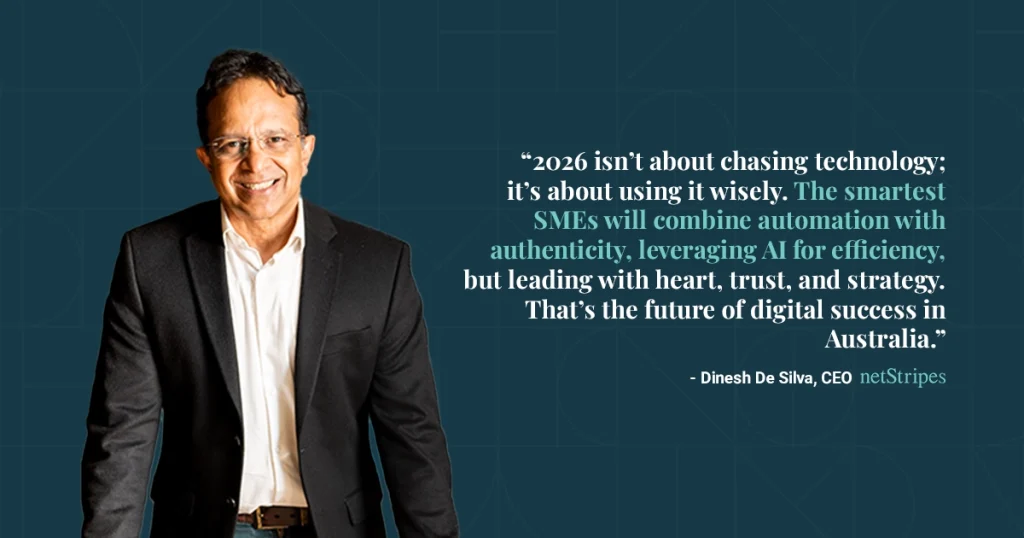
Featuring insights from Dinesh De Silva, CEO, NetStripes

From smarter AI tools to new ways of connecting with customers, technology is reshaping how small and medium businesses grow, market, and operate. The good news? You don’t need a massive budget to stay ahead of the digital trends 2026.

Most of these innovations that are reshaping the business world in 2026 are accessible and affordable, enabling small and medium-sized businesses to harness enterprise-level technology.

Here’s our guide to the 10 Digital Trends that matter most in 2026 and how you can apply them to gain an edge.

1. AI Assistants & Everyday Automation

Digital Trends 2026 AI

AI has officially become part of everyday business. By 2026, smart assistants will be doing much more than writing text; they’ll be managing schedules, qualifying leads, replying to emails, and even running parts of your business while you sleep.

Tools like ChatGPT Teams, Fyxer AI, HubSpot AI, n8n, and Zapier Agents are making automation easier and more affordable than ever.

Pro tip: Choose one repetitive task, such as appointment scheduling or customer follow-ups, and automate it. Once you see the time savings, you’ll be hooked.

2. Smarter Dashboards & Connected Tools

Digital Trends 2026 - dashboards

If you’re tired of juggling spreadsheets and tabs, you’ll love this trend. In 2026, more small businesses are connecting their website, socials, email, and ad platforms into one simple dashboard.

Tools like Looker Studio, Metricool, or Databox show you what’s working in real time, so you can make quick, confident decisions without having to refer to multiple sheets or tabs.

Pro tip: Start by linking your Google Analytics, Meta Ads, and CRM data into one dashboard. You’ll spot insights you’ve never seen before.

3. Generative AI: Fast, Creative, Affordable

Digital Trends 2026 - Gen AI

Generative AI is changing the way brands create ads, blogs, videos, and even customer testimonials. You no longer need a big marketing team to create great content. 

With Canva Magic Studio, Adobe Firefly, and ChatGPT, you can design visuals, write posts, and draft videos in minutes, all while keeping your unique style intact.

The most important thing is to keep your brand’s personality clear. AI can do much of the work, but your personal touch still makes content feel authentic and relatable.

Pro tip: Use AI for the first draft, then polish it with your personal touch. You’ll create faster and still sound like you.

4. Personalisation That Feels Human

Digital Trends 2026 - brands personalization

Customers expect more than generic messages. In 2026, personalisation means delivering the right message at the right time, without needing a big data team.

Nowadays, smart CRMs, social ad platforms, and eCommerce tools analyse real-time data to recommend products, predict needs, and deliver the right message at the right time.

AI-driven platforms like Mailchimp, ActiveCampaign, Shopify, and Meta Ads make this simple by analysing customer behaviour and suggesting what to say next.

Action tip: Try one personalised campaign, such as product recommendations or location-based offers. Measure how much better it performs than your usual emails.

5. Human Brands Win

Digital Trends 2026 - human brands

In a world that is dominated by automation and AI, authenticity has become your biggest competitive edge. 

Online consumers still crave a ‘’human touch’’ and want to know who they’re buying from. Your story, your values, and your passion all matter when it comes to selling your products or services.

By showing up as you, you create trust, relatability, and loyalty that no algorithm can replicate.

Pro tip: Create short videos or posts that share the story behind your business; why you started, what drives you, or even a glimpse of your team in action. Let your audience see the real faces and emotions behind the brand.

“Your greatest strength in the age of AI is still you.”

6. Strategy Before Software

Digital Trends 2026 - strategy before software

Before jumping into new tools or digital trends 2026, start with a clear digital strategy. Too many businesses are pouring money into websites, ads, or AI subscriptions without a clear direction and then end up wondering why the results fall short.

A strong digital strategy gives every action meaning. It connects your goals, audience, and resources so each decision moves your business forward with a purpose.

That’s where tools like netStripes’ Xell.ai come in handy, helping you refine your business strategy by identifying your strengths and uncovering opportunities before you invest.

Pro tip: Define your target audience, goals, and how you’ll measure success. When your strategy is prioritised, every tool you add works harder for you.

7. Customer Experience Is the New Marketing

Digital Trends 2026  - customer experience in marketing

Every click, email, and interaction shapes how customers perceive your business. In today’s hyper-connected world, marketing isn’t just about what you say; it’s about how people feel every time they engage with you.

The businesses winning in digital trends 2026 are those using digital tools to deliver seamless, stress-free experiences. That means faster responses, easier bookings, consistent communication, and proactive support, the kind that makes customers say, “That was simple.”

When your customer experience is smooth and reliable, it becomes your most powerful marketing tool, driving word-of-mouth, loyalty, and repeat sales automatically.

Action tip: Map your customer journey. Look for one area that causes friction (like response time or booking ease) and fix it with automation or AI.

Digital Trends 2026 - Conversational & Visual Search

People are no longer typing keywords, they’re asking questions and showing pictures.
AI-driven search tools like ChatGPT Search and Google’s AI Overviews are changing how customers find businesses.

Now, people ask questions like ‘Where can I find a family accountant near Parramatta?’ and AI tools respond with one or two top answers instead of a long list of links.

To stay discoverable, businesses need to optimise content for conversational and visual queries. That means writing in natural language, using structured data, and including clear visuals or videos where possible.

Pro tip: Update your website FAQ and blog sections to answer common customer questions directly. This format is more likely to be picked up by AI search engines and featured in conversational results.

9. Build Your Own Audience

Digital Trends 2026 - audience building

Social media is powerful, but it’s rented space. Algorithms shift, reach drops, and one policy change can make your audience disappear overnight.

The most successful business owners in 2026 are focusing on building their own micro-communities.

By building your own audience through newsletters, private groups, or membership content, you gain control over how and when you connect with customers. It’s not just about followers anymore, it’s about relationships that last beyond the feed.

When you create a direct line of communication, you can share valuable insights, announce new offers, and build loyalty without depending on social media platforms to do the work.

Action tip: Turn your best social content into a monthly email or private online group. It’s your space, not the algorithm’s.

10. Keep Learning, Always

Digital Trends 2026-Learning

Technology won’t slow down, and neither should you. The businesses that thrive in 2026 aren’t necessarily the biggest; they’re the ones that stay curious and keep adapting.

When learning becomes part of your company culture, innovation follows. Whether it’s exploring new digital tools, attending webinars, or encouraging your team to upskill, continuous learning keeps your business agile, competitive, and future-ready.

Action tip: Block an hour or two in your calendar each month to explore a new tool or digital trends 2026 on your own or as a team. Curiosity compounds over time.

Where to Begin

  1. Automate one task with AI.
  2. Connect your digital tools into a single view.
  3. Personalise your customer experience.
  4. Share your story online.
  5. Keep learning and improving every month.

You don’t need to do it all at once, just start slow, stay curious, and focus on progress, not perfection.

Digital Trends 2026 - Dinesh De Silva netstripes

Conclusion

2026 isn’t about chasing technology for technology’s sake.  It’s about using it wisely to save time, serve customers better, and grow your business with confidence with these top digital trends.

At netStripes, we believe innovation should always be practical, affordable, and human-centred, empowering business owners to do more, with less, while staying true to who they are.

To find out more about how you can apply these digital trends to your business, book a FREE digital advisory session with our digital strategists.


Australia’s SMEs at Crossroads: The Small Business Playbook for 2026

CPA Australia’s latest data reveals a widening gap between digital leaders and laggards, and outlines what SMEs can do about it.

Quick Snapshot

If you only have two minutes, here’s what you need to know:

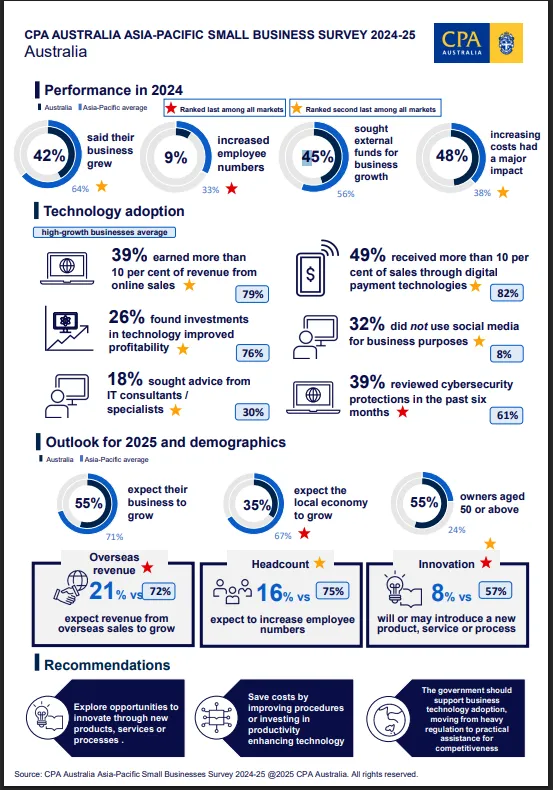
  • Only 42% of Australian SMEs grew in 2024 — well below the Asia-Pacific average of 64%.
  • While 74% Asia Pacific businesses plan to expand headcount in 2025, only 16% of Australian businesses will.
  • Just 39% earn more than 10% of their revenue online.
  • Growth expectations for 2025 rise slightly to 55%, but remain below those of regional peers.
  • Young leaders (under 40) and firms with 5–19 employees are the most likely to grow.
  • Businesses that invest in strategy, digital presence, and funding for innovation outperform others.

Bottom line: SMEs that lead with a clear strategy and digital capability will dominate 2025. The rest will struggle for visibility in an AI-driven marketplace.

The State of Australian SMEs in 2025

The CPA Australia 2024-25 Asia-Pacific Small Business Survey paints a clear picture: many Australian small businesses are cautious, even as opportunity expands globally.

While regional peers accelerate digital transformation, Australian SMEs risk being left behind due to slower adoption of e-commerce, underinvestment in marketing technology, and hesitation around growth funding.

At netStripes, we see this not as bad news, but as a wake-up call. It highlights exactly where strategic and digital innovation can make the biggest difference.

1. The Growth Gap

  • Only 42% of SMEs reported growth in 2024 versus 64% regionally.
  • Only 16% expected to hire vs 74%
  • Just 55% expect growth in 2025.
  • The top performers share common traits — they plan, measure, and act on digital opportunities.

Pro Tip: Review your 2024 metrics. If your revenue hasn’t grown by at least 10%, treat 2025 as your digital transformation year. Set tangible quarterly targets for leads, conversion, and online revenue.

2. The Digital Opportunity

Only 39% of Australian SMEs earn more than 10% of their revenue online. In contrast, in Singapore and mainland China, the majority exceed that benchmark.

Digital revenue is no longer just an extra stream — it’s the foundation of competitiveness. SMEs with high-conversion websites, clear strategy, and strong digital marketing outperform in visibility, trust, and sales conversion.

Pro Tip: Aim for 20–30% of total revenue to come from online channels by the end of 2025. Start with a website conversion audit and a strategic content plan aligned to your buyer’s journey.

3. Marketing and Technology Investment: Mind the ROI

Australian SMEs acknowledge the value of Marketing and technology, but fewer see real returns. This suggests many are investing without clear alignment to business outcomes.

At netStripes, we find that ROI comes when:

  • Tech and marketing investment is tied to clear goals.
  • Owners and Teams have a clear road map/ strategy and are trained to use the tools that deliver. 
  • Results are about a best practice process, takes multiple skill sets and a patient data-driven approach until lead flow is established for each business.
  • Establishing lead flow is about problem-solving until achievement, and it differs for every business. 
  • Data is reviewed regularly and acted upon.

Pro Tip: Don’t simply chase leads or silver bullets — establish best practice marketing processes, analysis of data, and a team that problem-solves until consistent repeatable lead flow is established. Patience is key.

4. Business Demographics and Growth Potential

CPA Australia’s data shows:

  • Younger leaders (under 40) and businesses aged 5–10 years are more likely to grow.
  • Firms with 5–19 employees perform best, balancing agility with resources.

This isn’t just demographic luck, it’s a mindset. These businesses are typically proactive, data-driven, and growth-oriented.

Pro Tip: No matter your age or business stage, you can emulate this mindset by setting measurable growth goals, adopting a learning culture, and reviewing strategy quarterly.

5. Access to Finance: The Growth Enabler

Businesses that grow are twice as likely to use external finance to fund innovation, marketing, and technology. This suggests that leveraging finance strategically rather than avoiding it, can accelerate growth.

Pro Tip: Prepare a Growth Funding Blueprint before approaching lenders. Detail how funding will generate returns — through business assets, digital marketing, automation, or website redevelopment.

Conclusion: 2026 The Year to Lead, Not Lag

The CPA Australia data shows a clear truth: growth is no longer a function of size, but of strategy.

SMEs that align their business goals with a powerful online presence, a data-driven marketing plan, and the right technology will lead their industries.

At netStripes, we’ve seen it time and again — when small businesses adopt clarity, strategy, and innovation, they don’t just grow; they transform.

2026 is your year to lead. Take charge with a strategy that’s grounded in data and executed with purpose. Because business leadership today begins and scales online.

CPA Australia’s latest data

source: www.cpaaustralia.com.au


The Ultimate Guide to Lead Generation for Small Businesses in Australia

In the Australian market, small businesses face distinct challenges in achieving sustainable growth. With over 2.6 million SMEs powering the national economy, generating consistent, high-quality leads is no longer a “nice-to-have” – it’s the difference between thriving and merely surviving. Whether you’re a trader in Sydney, a café owner in Melbourne, a professional services firm in Brisbane, or a retailer in regional Queensland, mastering lead generation will give you a predictable pipeline of customers.

At netStripes, we’re recognised by government bodies and industry associations as Australia’s trusted digital advisors for small and medium-sized enterprises. Our proven 5-step digital acceleration framework has helped hundreds of Australian businesses establish a world-class online presence and generate measurable results. This comprehensive guide shares the exact strategies we use with our clients – fully compliant, practical, and tailored for the Australian market.

What is Lead Generation and Why Australian SMEs Can’t Ignore It

Lead generation is the process of attracting and converting strangers into prospects who have actively shown interest in your products or services. For Australian small businesses, this means turning online visibility into real-world enquiries – such as quote requests, bookings, consultations, or sales.

Recent data shows:

  • Eighty per cent of “near me” searches on Google result in a conversion.
  • Businesses that actively nurture leads see 45% higher conversion rates.
  • Australian SMEs using multi-channel lead generation grow their revenue 3× faster than those relying on word-of-mouth alone.

Most importantly, getting this wrong can be expensive. Non-compliance with the Spam Act 2003 or Australian Privacy Principles can result in fines up to $2.5 million – we’ll show you how to stay 100% compliant.

Know Your Ideal Australian Customer Inside Out

The foundation of every successful lead generation campaign is a crystal-clear understanding of the audience. Ask yourself:

  • Are your customers local (e.g., Sydney’s Inner West families) or national (e.g., e-commerce serving all states)?
  • What are their biggest pain points right now – cost-of-living pressures, labour shortages, supply chain issues?
  • Where do they hang out online – Facebook groups, LinkedIn, Google, TikTok?

Action step: Build 2–3 detailed buyer personas using Australian Bureau of Statistics data, Google Analytics, and your own CRM insights.

Proven Lead Generation Strategies for Australian Small Businesses

Here are the most effective, compliant channels we recommend (and implement) for NetStripes clients:

1. Local SEO – Your Biggest Free Lead Source

Australians love supporting local businesses. “Near me” and service + suburb searches dominate Google.

Must-do actions:

  • Fully optimise your Google Business Profile (photos, services, posts, Q&A, reviews).
  • Get consistent NAP (Name, Address, Phone) across 50+ Australian directories.
  • Target long-tail keywords like “emergency plumber Bondi” or “family lawyer Perth northern suburbs”.
  • Actively request Google reviews – 97% of Australians read them before contacting a business.

netStripes clients typically see 150–300% increases in organic enquiries within 3–6 months.

2. Content Marketing + Irresistible Lead Magnets

Give value first to earn trust and contact details (with explicit consent).

Popular Australian lead magnets that work:

  • “ATO-Compliant Tax Checklist for Tradies”
  • “2024–25 Café Profitability Guide – How to Beat Rising Costs”
  • “NDIS Provider Compliance Toolkit”
  • Regional grants and funding cheat sheets

Host them on a fast, mobile-optimised website and gate them behind a simple opt-in form.

3. Google Ads & Microsoft Advertising (PPC)

Perfect for immediate, high-intent traffic.

Best campaigns for Australian SMEs:

  • Search campaigns targeting “emergency” or “best” keywords.
  • Local Services Ads (great for tradies and home services – pay per lead, not click).
  • Remarketing to website visitors.

Start with $500–$2,000/month and scale aggressively once ROI is proven.

4. Meta Advertising (Facebook & Instagram)

Still the king for consumer-facing Australian businesses.

Winning tactics:

  • Lead Ads with pre-filled forms (frictionless on mobile).
  • Lookalike audiences built from your best existing customers.
  • Hyper-local targeting down to the postcode level.
  • Creative that speaks Australian – think backyard BBQs, footy season, or beach lifestyles.

5. LinkedIn – The B2B Goldmine

If you sell to other businesses, LinkedIn outperforms everything else in Australia.

Strategies:

  • Organic content + thought leadership (post about industry regulations, case studies).
  • Sponsored Content and InMail campaigns targeting job titles and industries.
  • Lead Gen Forms that sync directly to your CRM.

6. Compliant Email Marketing & Lead Nurturing

Once you have permission, email remains one of the highest-ROI channels.

Australian compliance checklist (Spam Act 2003):

  • Express or properly inferred consent only.
  • Clear identification of sender.
  • Working unsubscribe link (processed within 5 business days).
  • No purchased or scraped lists – ever.

Use sequences like:

  • Welcome series.
  • Educational drip campaigns.
  • Re-engagement for cold leads.

7. Strategic Partnerships & Referral Systems

Never underestimate old-school tactics turbocharged with digital.

Ideas:

  • Cross-promotions with complementary local businesses.
  • Formalised referral partnerships (e.g., accountants referring to bookkeepers).
  • Customer referral incentives (structured to comply with Australian Consumer Law).

Tools & Technology Stack We Recommend for Australian SMEs

  • Website & forms: WordPress + Elementor or Webflow (NetStripes builds both)
  • CRM & automation: HubSpot (free tier excellent), ActiveCampaign, or Klaviyo
  • Analytics: Google Analytics 4 + Google Tag Manager
  • Review management: Trustpilot or Birdeye
  • Compliance: OneTrust or Termly for privacy policies

Measuring What Matters – KPIs That Actually Drive Growth

Track these every month:

  • Cost per lead (CPL) by channel
  • Lead-to-customer conversion rate
  • Customer lifetime value vs customer acquisition cost
  • Return on ad spend (ROAS)

Aim for a 3:1 lifetime value to acquisition cost ratio as your north star.

Ready to Build Your Predictable Lead Generation Machine?

Lead generation doesn’t have to be complicated or expensive – but it does need to be strategic, compliant, and consistent.

At netStripes, we’ve helped Australian small businesses across every state and industry generate millions in additional revenue through digital lead generation done right.

If you’re ready to stop hoping for the phone to ring and start building a system that delivers qualified leads every single week, let’s talk.

Book your free Digital Growth Diagnostic today at www.netstripes.com and discover exactly where the biggest opportunities are hiding in your business.