AI Automation with Openclaw: The Complete Business Owner’s Guide

How ambitious SMEs can turn AI into a reliable growth engine

Executive summary — why you should read this

Every week I speak with business owners who feel overwhelmed by the growing list of tools, platforms, and tasks required just to keep their business running. Emails, enquiries, proposals, follow-ups, onboarding, reporting, internal coordination — the list never ends.

Most businesses are not short of ideas. They are short of time, capacity, and consistency.

This is where AI automation platforms like Openclaw are becoming transformational.

But here is the reality I see every day:
Many businesses try automation, set up a few workflows, and quietly abandon it within months. Not because the technology doesn’t work — but because the strategy behind it was missing.

This guide is different.

We are going to combine:

  • A practical step-by-step understanding of Openclaw
  • The real business strategy needed to make automation succeed
  • The governance, adoption, and ROI frameworks most guides ignore
  • Clear, actionable pro tips you can implement immediately

If you are an ambitious business owner who wants to build a reliable growth engine, this article will show you how AI automation can become one of the most valuable team members you will ever hire.

The reality facing modern SMEs

Small and mid-sized businesses are expected to operate like large enterprises — but with a fraction of the resources.

You must:

  • Respond to enquiries instantly
  • Deliver excellent customer experience
  • Maintain marketing momentum
  • Keep operations efficient
  • Support your team
  • And still grow revenue

This pressure is not slowing down. It is accelerating.

Openclaw AI automation is no longer a “nice to have”. It is quickly becoming a competitive advantage.

Businesses that adopt it strategically will move faster, respond quicker, and scale more efficiently than competitors who rely solely on manual processes.

What Openclaw actually is- in simple terms

Think of Openclaw as a 24/7 digital operations assistant.

It connects your tools, listens for triggers, and performs tasks automatically.

It can:

  • Monitor emails, forms, and customer interactions
  • Update your CRM
  • Send responses and notifications
  • Create tasks and workflows
  • Generate reports
  • Route enquiries to the right people

In practical terms, it removes repetitive work from your team so they can focus on higher-value activities.

Many businesses save 10–20 hours per week once automation is implemented properly.

Before you start: the most important mindset shift

The biggest mistake businesses make is this:

They think automation is about technology.

It is not.

Openclaw automation is about business outcomes.

Technology is simply the tool.

Before touching any platform, we must answer one question:

What business problems are we trying to solve?

Step 1 — Define your automation success metrics

If you skip this step, automation will fail.

Before setting up Openclaw, define success clearly.

Your automation success framework

Choose metrics in three categories:

1) Efficiency metrics

  • Hours saved per week
  • Tasks automated per month
  • Reduction in manual work

2) Revenue metrics

  • Lead response speed
  • Conversion rate improvements
  • Sales cycle reduction

3) Customer experience metrics

  • Response time
  • Consistency of communication
  • Customer satisfaction

Pro tip

Start with a simple target:
Save 10 hours per week within 90 days.

This is achievable and measurable.

Step 2 — Choose high-ROI automation first

Do not automate everything.

Start with high-impact workflows.

The top 5 automations every SME should start with

1) Lead capture and routing

When a website enquiry arrives:

  • Capture details
  • Send confirmation email
  • Add to CRM
  • Assign to salesperson
  • Create follow-up task

Instant response dramatically increases conversions.

2) Sales follow-up sequences

Most leads are lost due to slow or inconsistent follow-up.

Openclaw Automation can:

  • Send follow-up emails
  • Schedule reminders
  • Track responses

3) Customer onboarding

New clients need:

  • Welcome emails
  • Information requests
  • Task creation
  • Internal notifications

Automation ensures a professional, consistent experience.

4) Internal reporting

Weekly reports often consume hours.

Automation can:

  • Collect data
  • Generate summaries
  • Send dashboards to leadership.

5) Appointment and meeting workflows

Openclaw Automate confirmations, reminders, and follow-ups.

This reduces no-shows and improves customer experience.

Step 3- Setting up Openclaw

The technical setup is straightforward.

You will need:

  • A professional email account
  • Admin access to tools you want to connect
  • Basic understanding of workflows
  • About 30–60 minutes for initial setup

Account creation

  • Register your account
  • Verify email and enable security
  • Choose your plan
  • Complete your profile

Configure your AI assistant

Define:

  • Name and personality
  • Tone and language
  • Permissions and access levels

Pro tip

Start with restrictive permissions and expand gradually.

Step 4- Integrate your business tools

The power of Openclaw comes from integration.

Common integrations include:

  • Google Workspace
  • Slack or Teams
  • CRM platforms
  • Marketing tools
  • Calendar systems
  • Zapier and APIs

The goal is to create a single automation layer across your tech stack.

Step 5 — Build your first workflows

Automation works through triggers and actions.

Examples of triggers:

  • New email received
  • Form submission
  • Calendar booking
  • CRM update

Examples of actions:

  • Send notification
  • Create task
  • Update database
  • Send email response

Pro tip

Start with simple workflows and expand gradually.

The part most guides ignore: team adoption

Technology does not fail.
Adoption fails.

Your team must understand:

  • Why automation is being introduced
  • How it helps them
  • What tasks it will support

Internal launch strategy

  1. Announce the initiative clearly
  2. Explain the benefits
  3. Provide training
  4. Celebrate early wins

Position automation as a support tool, not a replacement.

Data privacy and security considerations

This is essential.

Before connecting systems, define:

  • What data can be accessed
  • Who has permission
  • How access is monitored

Establish:

  • Access controls
  • Audit trails
  • Permission reviews

This protects your business and your clients.

AI guardrails and risk management

Openclaw AI must operate within clear boundaries.

Define:

  • When automation should escalate to humans
  • Approval processes for customer communications
  • Brand voice guidelines

Always include a human-in-the-loop for critical communication.

Your knowledge base strategy

AI is only as good as the knowledge it uses.

Prepare:

  • FAQs
  • Service descriptions
  • Processes
  • Templates
  • Documentation

Maintain and update this regularly.

This dramatically improves automation performance.

Measuring ROI and performance

Track Openclaw automation weekly and monthly.

Key metrics:

  • Hours saved
  • Tasks automated
  • Response time improvements
  • Conversion improvements
  • Cost savings

Pro tip

Create a simple automation dashboard and review monthly.

Your automation maturity roadmap

Automation evolves over time.

Stage 1 — Starter

Basic workflows and quick wins.

Stage 2 — Operational

Cross-tool workflows.

Stage 3 — Scaled

Multi-department automation.

Stage 4 — Intelligent

AI insights and predictions.

Stage 5 — Autonomous

Advanced AI-driven operations.

Think long-term.

Department automation opportunities

Sales

  • Lead qualification
  • Follow-ups
  • Proposal generation

Marketing

  • Campaign reporting
  • Content workflows
  • Lead nurturing

Customer service

  • Enquiry routing
  • FAQ responses
  • Ticket creation

HR

  • Recruitment workflows
  • Onboarding processes

Finance

  • Invoice reminders
  • Reporting automation

Cost and ROI expectations

Most SMEs recover automation investment quickly.

Typical outcomes:

  • 10–20 hours saved weekly
  • Faster lead response
  • Improved customer experience
  • Reduced operational overhead

Automation often pays for itself within months.

Your first 90-day automation roadmap

Month 1

  • Define goals
  • Connect tools
  • Launch first workflows

Month 2

  • Expand automations
  • Train team
  • Track results

Month 3

  • Optimise workflows
  • Measure ROI
  • Plan next stage

Final thoughts

AI automation is not about replacing people.

It is about empowering your team to focus on meaningful work.

Businesses that adopt automation strategically will:

  • Move faster
  • Respond quicker
  • Scale more efficiently
  • Deliver better customer experiences

This is how you turn AI into a reliable growth engine.

Actionable pro tips recap

  1. Start with clear business goals.
  2. Automate high-ROI workflows first.
  3. Focus on team adoption.
  4. Protect data and set AI guardrails.
  5. Measure results and iterate.

If you have been considering automation, now is the time to start.

The businesses that act early will create a meaningful competitive advantage in the years ahead.
Best SEO Services for Small Businesses in Sydney 2027

Sydney’s small businesses face fierce local competition in 2027, from bustling CBD cafes to Inner West tradies and Eastern Suburbs professionals. With AI reshaping search—driving fewer clicks but higher-intent traffic—effective SEO remains essential for visibility, leads, and sustainable growth. Australian SMEs investing in smart SEO see strong ROI, often outpacing paid ads in long-term cost efficiency. In a market where over 70% of consumers start with local searches, tailored SEO services help Sydney small businesses dominate Google, Maps, and emerging AI overviews. The right partner delivers measurable results without breaking tight budgets.

Sydney’s Small Business SEO Landscape in 2027

Sydney SMEs navigate rising costs, regulatory shifts, and evolving consumer habits. Local searches dominate, with “near me” queries surging and AI assistants influencing recommendations. Trends like Answer Engine Optimisation (AEO), Generative Engine Optimisation (GEO), and entity-based search reward authoritative, helpful content over keyword stuffing.

Small businesses benefit from hyper-local focus—optimising for suburbs like Bondi, Parramatta, or North Sydney—while adapting to AI-driven results. Challenges include limited budgets and time, but opportunities abound: updated Google Business Profiles, strong E-E-A-T (Experience, Expertise, Authoritativeness, Trustworthiness), and voice/local search yield quick wins. Data shows top local pack rankings capture significant clicks, making specialised SEO crucial for outpacing competitors.

Key SEO Trends Shaping 2027 for Sydney Small Businesses

2027 SEO evolves beyond traditional rankings.

AI and AEO/GEO Dominance — Optimise for AI overviews and generative answers. Focus on being cited in zero-click results through structured data, schema markup, and brand mentions.

Local SEO Expansion — Beyond Google Business Profile: consistent NAP across directories, review management, and geo-targeted content for Sydney suburbs.

People-First Content — High-quality, original content with first-hand experience outperforms AI-generated material. Topic clusters around pillar pages build authority.

Technical Foundations — Core Web Vitals, mobile speed, crawlability, and accessibility remain non-negotiable for AI and user trust.

Voice and Personalised Search — Conversational queries and location-based intent require natural language optimisation.

Cross-Channel Visibility — Mentions, reviews, and PR citations boost entity signals for AI recommendations.

These shifts favour agile small businesses partnering with experts who deliver tailored, ethical strategies.

What to Look for in the Best SEO Services for Sydney SMEs

Top services prioritise transparency, results, and affordability.

Proven Local Expertise — Sydney-focused agencies understand suburb nuances and competition.

Custom Strategies — No one-size-fits-all: technical audits, on-page optimisation, content planning, link building, and local pack dominance.

Transparent Reporting — Monthly insights on rankings, traffic, leads, and ROI.

Ethical Practices — White-hat techniques avoiding penalties.

Budget-Friendly Packages — Entry-level from $1,000–$2,500/month for SMEs, scaling with growth.

AI-Ready Tactics — Tools for keyword forecasting, content optimisation, and AEO.

Look for agencies with strong reviews, case studies from similar businesses, and no lock-in contracts.

Step-by-Step Guide to Choosing and Implementing SEO Services

  • Assess Needs — Audit your site for technical issues, Google Business Profile health, and current rankings. Set goals like 30% lead increase.

  • Research Providers — Compare via Clutch, Semrush, or local directories. Prioritise Sydney-based with SME focus.

  • Request Proposals — Seek free audits and clear plans. Ask about AEO strategies and local SEO tactics.

  • Start Small — Begin with technical fixes and content optimisation for quick wins.

  • Execute and Monitor — Launch on-page changes, build content clusters, manage reviews. Track via Google Analytics and Search Console.

  • Optimise Continuously — Review monthly; adjust for algorithm updates and performance.

Allocate 8-12% of revenue initially, focusing on high-ROI areas like local SEO.

Overcoming Common Challenges for Sydney Small Businesses

Budget constraints? Opt for phased approaches starting with essentials. Time-poor? Choose agencies handling execution. Competition? Hyper-local content and reviews differentiate you.

Many SMEs succeed by partnering with specialists who deliver tailored plans without overwhelming costs.

Conclusion: Partner with netStripes for Top-Tier SEO Results

In 2026, the best SEO services empower Sydney small businesses to thrive amid AI changes, securing visibility, trust, and growth. By focusing on local relevance, quality content, and emerging trends, you build lasting digital equity.

netStripes, a leading Sydney-based digital marketing agency and web design company, excels in SEO tailored for SMEs. With expertise in local SEO, technical optimisation, content strategy, Google Ads integration, and data-driven approaches, netStripes delivers transparent, results-focused services. Their team helps refine your online presence, target Sydney suburbs effectively, and adapt to 2026 trends like AEO and GEO for measurable leads and revenue.

Ready to elevate your SEO and outrank local competitors? Contact us today for a complimentary SEO audit and consultation—unlock your business’s full potential in Sydney’s competitive market.


Digital Trends 2026: What Every Small Business Owner Should Know

Featuring insights from Dinesh De Silva, CEO, NetStripes

From smarter AI tools to new ways of connecting with customers, technology is reshaping how small and medium businesses grow, market, and operate. The good news? You don’t need a massive budget to stay ahead of the digital trends 2026.

Most of these innovations that are reshaping the business world in 2026 are accessible and affordable, enabling small and medium-sized businesses to harness enterprise-level technology.

Here’s our guide to the 10 Digital Trends that matter most in 2026 and how you can apply them to gain an edge.

1. AI Assistants & Everyday Automation

Digital Trends 2026 AI

AI has officially become part of everyday business. By 2026, smart assistants will be doing much more than writing text; they’ll be managing schedules, qualifying leads, replying to emails, and even running parts of your business while you sleep.

Tools like ChatGPT Teams, Fyxer AI, HubSpot AI, n8n, and Zapier Agents are making automation easier and more affordable than ever.

Pro tip: Choose one repetitive task, such as appointment scheduling or customer follow-ups, and automate it. Once you see the time savings, you’ll be hooked.

2. Smarter Dashboards & Connected Tools

Digital Trends 2026 - dashboards

If you’re tired of juggling spreadsheets and tabs, you’ll love this trend. In 2026, more small businesses are connecting their website, socials, email, and ad platforms into one simple dashboard.

Tools like Looker Studio, Metricool, or Databox show you what’s working in real time, so you can make quick, confident decisions without having to refer to multiple sheets or tabs.

Pro tip: Start by linking your Google Analytics, Meta Ads, and CRM data into one dashboard. You’ll spot insights you’ve never seen before.

3. Generative AI: Fast, Creative, Affordable

Digital Trends 2026 - Gen AI

Generative AI is changing the way brands create ads, blogs, videos, and even customer testimonials. You no longer need a big marketing team to create great content. 

With Canva Magic Studio, Adobe Firefly, and ChatGPT, you can design visuals, write posts, and draft videos in minutes, all while keeping your unique style intact.

The most important thing is to keep your brand’s personality clear. AI can do much of the work, but your personal touch still makes content feel authentic and relatable.

Pro tip: Use AI for the first draft, then polish it with your personal touch. You’ll create faster and still sound like you.

4. Personalisation That Feels Human

Digital Trends 2026 - brands personalization

Customers expect more than generic messages. In 2026, personalisation means delivering the right message at the right time, without needing a big data team.

Nowadays, smart CRMs, social ad platforms, and eCommerce tools analyse real-time data to recommend products, predict needs, and deliver the right message at the right time.

AI-driven platforms like Mailchimp, ActiveCampaign, Shopify, and Meta Ads make this simple by analysing customer behaviour and suggesting what to say next.

Action tip: Try one personalised campaign, such as product recommendations or location-based offers. Measure how much better it performs than your usual emails.

5. Human Brands Win

Digital Trends 2026 - human brands

In a world that is dominated by automation and AI, authenticity has become your biggest competitive edge. 

Online consumers still crave a ‘’human touch’’ and want to know who they’re buying from. Your story, your values, and your passion all matter when it comes to selling your products or services.

By showing up as you, you create trust, relatability, and loyalty that no algorithm can replicate.

Pro tip: Create short videos or posts that share the story behind your business; why you started, what drives you, or even a glimpse of your team in action. Let your audience see the real faces and emotions behind the brand.

“Your greatest strength in the age of AI is still you.”

6. Strategy Before Software

Digital Trends 2026 - strategy before software

Before jumping into new tools or digital trends 2026, start with a clear digital strategy. Too many businesses are pouring money into websites, ads, or AI subscriptions without a clear direction and then end up wondering why the results fall short.

A strong digital strategy gives every action meaning. It connects your goals, audience, and resources so each decision moves your business forward with a purpose.

That’s where tools like netStripes’ Xell.ai come in handy, helping you refine your business strategy by identifying your strengths and uncovering opportunities before you invest.

Pro tip: Define your target audience, goals, and how you’ll measure success. When your strategy is prioritised, every tool you add works harder for you.

7. Customer Experience Is the New Marketing

Digital Trends 2026  - customer experience in marketing

Every click, email, and interaction shapes how customers perceive your business. In today’s hyper-connected world, marketing isn’t just about what you say; it’s about how people feel every time they engage with you.

The businesses winning in digital trends 2026 are those using digital tools to deliver seamless, stress-free experiences. That means faster responses, easier bookings, consistent communication, and proactive support, the kind that makes customers say, “That was simple.”

When your customer experience is smooth and reliable, it becomes your most powerful marketing tool, driving word-of-mouth, loyalty, and repeat sales automatically.

Action tip: Map your customer journey. Look for one area that causes friction (like response time or booking ease) and fix it with automation or AI.

Digital Trends 2026 - Conversational & Visual Search

People are no longer typing keywords, they’re asking questions and showing pictures.
AI-driven search tools like ChatGPT Search and Google’s AI Overviews are changing how customers find businesses.

Now, people ask questions like ‘Where can I find a family accountant near Parramatta?’ and AI tools respond with one or two top answers instead of a long list of links.

To stay discoverable, businesses need to optimise content for conversational and visual queries. That means writing in natural language, using structured data, and including clear visuals or videos where possible.

Pro tip: Update your website FAQ and blog sections to answer common customer questions directly. This format is more likely to be picked up by AI search engines and featured in conversational results.

9. Build Your Own Audience

Digital Trends 2026 - audience building

Social media is powerful, but it’s rented space. Algorithms shift, reach drops, and one policy change can make your audience disappear overnight.

The most successful business owners in 2026 are focusing on building their own micro-communities.

By building your own audience through newsletters, private groups, or membership content, you gain control over how and when you connect with customers. It’s not just about followers anymore, it’s about relationships that last beyond the feed.

When you create a direct line of communication, you can share valuable insights, announce new offers, and build loyalty without depending on social media platforms to do the work.

Action tip: Turn your best social content into a monthly email or private online group. It’s your space, not the algorithm’s.

10. Keep Learning, Always

Digital Trends 2026-Learning

Technology won’t slow down, and neither should you. The businesses that thrive in 2026 aren’t necessarily the biggest; they’re the ones that stay curious and keep adapting.

When learning becomes part of your company culture, innovation follows. Whether it’s exploring new digital tools, attending webinars, or encouraging your team to upskill, continuous learning keeps your business agile, competitive, and future-ready.

Action tip: Block an hour or two in your calendar each month to explore a new tool or digital trends 2026 on your own or as a team. Curiosity compounds over time.

Where to Begin

  1. Automate one task with AI.
  2. Connect your digital tools into a single view.
  3. Personalise your customer experience.
  4. Share your story online.
  5. Keep learning and improving every month.

You don’t need to do it all at once, just start slow, stay curious, and focus on progress, not perfection.

Digital Trends 2026 - Dinesh De Silva netstripes

Conclusion

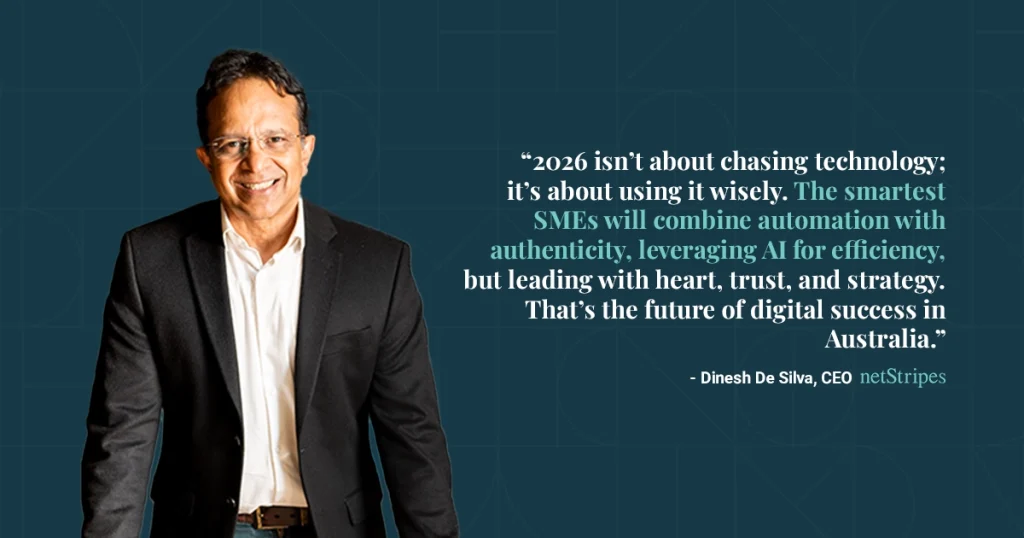
2026 isn’t about chasing technology for technology’s sake.  It’s about using it wisely to save time, serve customers better, and grow your business with confidence with these top digital trends.

At netStripes, we believe innovation should always be practical, affordable, and human-centred, empowering business owners to do more, with less, while staying true to who they are.

To find out more about how you can apply these digital trends to your business, book a FREE digital advisory session with our digital strategists.