SEO Strategies to Grow Your Real Estate Business in Australia 2026

Before a buyer ever steps foot in an open home, they start on Google. In a competitive 2026 market, if agents aren’t found there, they aren’t considered. Right now in 2026, the Australian property market is still moving forward, even with all the talk about interest rates and affordability. Forecasts show national house prices could climb around 7-8% this year, with places like Perth and Brisbane leading the way. It’s a competitive space – buyers and sellers are searching online first, often starting with Google to check suburb prices, recent sales, or local agents.

If your agency isn’t showing up high in those searches, you’re missing out on people who are ready to buy, sell, or rent. SEO Strategies to Grow Your Real Estate Business, which helps you get found naturally, brings in better-quality leads, and cuts down on spending big on ads or portal fees. The best part? Once you’re ranking well, the traffic keeps coming without constant extra costs.

In this guide, We walk you through practical steps that actually work for Australian real estate agents and agencies right now. These are based on what’s ranking today and what Google cares about after the latest updates.

Why Focusing on SEO Makes Sense This Year

People don’t just browse – they search with real intent. Queries like “houses for sale in [suburb]” or “best real estate agent near me Brisbane” happen every day. Local searches are huge, and with more folks using voice search on phones, natural questions like “what’s the property market like in Perth right now?” are common.

Google keeps rewarding sites that feel helpful and trustworthy – showing real local knowledge, fresh info, and proof you’ve been in the trenches. Agencies posting genuine suburb updates, sold prices, and honest advice do much better than those with generic pages.

1. Get Your Keyword Research Spot-On for Local Searches

Don’t chase broad terms like “real estate agent” – they’re too crowded. Instead, dig into what people in your area are actually typing.

Use free tools like Google Keyword Planner or paid ones like Ahrefs/SEMrush to find:

  • Specific buyer searches: “3 bedroom house for sale Toorak VIC”, “investment properties Gold Coast under 600k”
  • Seller questions: “how to sell my home quickly in Adelaide 2026”, “current house prices Fremantle”
  • Everyday local ones: “real estate agent South Yarra reviews”, “auction results Byron Bay this weekend”

Look for longer phrases (long-tail keywords) with decent searches but less competition. Add in Aussie ways of asking things, since voice search loves conversational language.

Group them into topics. Build a main guide like “Selling Your Home in Melbourne This Year” and link to supporting posts about staging tips, pricing realistically, or what to expect at auction.

Check and update your list every few months – things shift with rates, new developments, or migration patterns.

2. Make Every Page on Your Site Work Harder

Once you’ve got your keywords, put them in naturally where they belong.

  • Page titles and meta descriptions: Start with the location and main service, e.g., “Real Estate Agents in Brighton VIC | Sell or Buy with Confidence”
  • Headings: Use clear H1 for the main topic, H2/H3 for sections like recent sales, school zones, or buyer tips.
  • Property listings: Write detailed descriptions that include key details (bedrooms, land size, features). Add good photos with alt text like “modern kitchen in 4-bed family home Brighton”.
  • Link internally: Connect related pages so visitors (and Google) can easily move around your site.

Add video tours or short suburb walkthroughs – people stay longer when they see real visuals.

3. Fix the Technical Basics So Google Loves Your Site

SEO Strategies to Grow Your Real Estate Business

A slow or clunky site loses people fast – and Google notices.

Focus on:

  • Speed: Get pages loading in under 3 seconds (compress images, use caching, maybe a CDN).
  • Mobile-friendly: Most searches happen on phones, so test everything looks good and works smoothly.
  • Structured data: Add schema for your business (address, phone, reviews) and for listings to help rich results show up.
  • Clean URLs: Something like yoursite.com/homes-for-sale-perth-north instead of random numbers.

Run a quick check with Google Search Console to spot broken links or other easy fixes.

4. Own Local Search – This Is Where Most Leads Come From

For real estate, being strong locally is everything.

  • Google Business Profile: Claim it, fill out every section completely (hours, services, areas you cover). Add fresh photos of recent sales, your team, and the office. Post weekly about new listings, market snippets, or open homes. Reply to every review quickly – good ones build trust fast.
  • Get listed consistently: Make sure your name, address, and phone number (NAP) match exactly on sites like Yellow Pages, TrueLocal, Localsearch, and the big portals.
  • Suburb-specific pages: Create one solid page per area you work in. Include local stats (recent sold prices, average days on market), info on schools/transport/cafes, and real client stories. This helps you show up in the map pack and regular results.

5. Write Content People Actually Read and Trust

Google wants content that shows you know your stuff – not just filler.

Try:

  • Monthly suburb reports: “What’s Happening in Brisbane Property Right Now – Prices, Sales, Trends”
  • Helpful guides: “First Home Buyer Steps in Sydney 2026”, “How to Get Your Home Ready for Auction in Perth”
  • Video explainers or quick tips embedded on pages

Show your experience – add team bios with real sales history and qualifications. Update old posts when things change (like new interest rate moves).

6. Build Links the Right Way

Good links from relevant sites still help a lot.

Ways to earn them:

  • Team up with local brokers, solicitors, or builders for joint content or shout-outs.
  • Get involved in community stuff – sponsor a local event and get mentioned naturally.
  • Share useful original info (like a suburb comparison tool or growth report) that others link to.

Stick to quality Australian sites – skip spammy directories.

7. Keep an Eye on What’s Working

Track with Google Analytics and Search Console:

  • How much organic traffic and actual enquiries you’re getting
  • Which keywords are climbing
  • How often you appear in local map results

Look monthly and tweak as needed. Small steady improvements add up to big lead growth over time.

Things to Steer Clear Of

Skip keyword stuffing, buying dodgy links, or letting your Google profile sit untouched. Don’t publish thin or copied content – it hurts more than helps these days.

Wrapping It Up

Getting SEO right lets you attract serious buyers and sellers straight to your door without always paying for clicks. In a market that’s still growing (especially in spots like Perth, Brisbane, and Adelaide), being visible locally builds your reputation and fills your pipeline with better leads.

Start small: tidy up your Google Business Profile today, pick one suburb to build a strong page for, and check your site’s speed. Consistent effort pays off.

At netstripes, we help real estate businesses across Australia put these exact steps into action – from site tweaks and local optimisation to content that ranks and converts. We keep it straightforward and focused on real results for your agency.

Want to see how this could work for your specific areas and get more direct enquiries? Book a free, no-pressure chat to see how we can help you dominate your local market. We’ll review your current setup and map out quick wins to help you stand out in 2026.
Custom Website Development Tips for Brisbane E-Commerce Stores

In Brisbane’s thriving retail scene, e-commerce stores are capitalising on Queensland’s growing online market. With Australia’s e-commerce sector expanding rapidly—projected to reach significant milestones by 2030 and mobile purchases dominating 70-80% of transactions—local businesses must invest in custom websites to stand out. Brisbane e-commerce players benefit from strong logistics, proximity to innovation hubs, and a consumer base that values fast delivery, local relevance, and seamless experiences. Custom development allows tailored solutions that off-the-shelf platforms often can’t match, enabling better personalisation, integrations, and performance. In 2026, Brisbane stores adopting custom approaches see higher conversions through AI features, mobile optimisation, and authentic branding that resonates with Queensland shoppers.

Brisbane’s E-Commerce Landscape in 2026

Brisbane’s e-commerce market thrives amid Australia’s broader growth, where online sales form a substantial share of retail. High disposable incomes in suburbs like the CBD, Fortitude Valley, and South Brisbane drive demand for personalised shopping. Trends show strong mobile commerce uptake, with 70-80% of purchases on phones, alongside rising expectations for instant or same-day delivery—boosted by trials in SEQ like drone services. Consumers prioritise sustainability, local products, and trust signals such as “made in Australia” or Brisbane-specific messaging. Competition from national players intensifies, but custom sites help local stores differentiate with geo-targeted features, faster load times, and integrations suited to Queensland’s supply chains. Those investing in custom development gain edges in personalisation and scalability.

Key Trends Driving Custom E-Commerce Development in 2026

e- commerce

Custom websites align with 2026’s top Australian e-commerce shifts.

  • Mobile-first and responsive design are essential, as most traffic comes from phones. Prioritise lightning-fast loading, intuitive touch navigation, and AMP-like performance.
  • AI Personalisation transforms experiences with dynamic recommendations, chatbots, and predictive search based on user behaviour.
  • Headless Commerce decouples frontend from backend for flexibility—ideal for custom UIs while using robust backends like Shopify or BigCommerce APIs.
  • Social Commerce Integration embeds shoppable posts from Instagram and TikTok directly.
  • Sustainability Features highlight eco-friendly products, carbon calculators, or local sourcing to appeal to conscious Brisbane buyers.
  • BNPL and Secure Payments with local options build trust.
  • Hyperlocal Elements include state-specific shipping, Brisbane weather-themed promotions, or suburb-targeted content.

These trends reward custom builds over templates, offering deeper control for Brisbane’s competitive market.

Core Tips for Custom Website Development

Focus on these elements for high-performing Brisbane e-commerce sites.

  • Choose the Right Tech Stack — Use headless setups with frameworks like Next.js or Gatsby for speed. Pair with platforms like Shopify Plus, WooCommerce, or BigCommerce for commerce logic, allowing full frontend customisation.
  • Prioritise User Experience (UX) — Implement streamlined navigation, high-quality images, zoom features, and quick-view options. Reduce friction with one-click checkout and guest options.
  • Incorporate AI and Automation — Add personalised product suggestions, abandoned cart recovery, and AI chat for queries.
  • Optimise for Speed and SEO — Use Core Web Vitals, image optimisation, and schema markup. Target local searches like “Brisbane online fashion” with geo-optimised content.
  • Ensure Mobile Optimisation — Test rigorously across devices; adopt progressive web app (PWA) features for app-like feel.
  • Build Strong Security and Compliance — Implement SSL, PCI-DSS compliance, GDPR-like privacy, and secure payments.
  • Integrate Local Logistics — Connect with Australia Post, Sendle, or local couriers for real-time tracking and Brisbane-fast delivery.
  • Focus on Accessibility and Inclusivity — Meet WCAG standards for broader reach.

Step-by-Step Guide to Custom Development

Extend A Home Website: Free Guide Page
  1. Define Goals and Audience — Research Brisbane demographics; set KPIs like conversion rate or AOV.
  2. Select Platform and Team — Choose headless-capable base; partner with experienced developers familiar with Australian e-commerce.
  3. Plan Architecture — Design scalable backend with APIs; map user journeys.
  4. Design and Prototype — Create wireframes emphasising mobile; incorporate brand elements like Queensland-inspired visuals.
  5. Develop Core Features — Build product catalogue, cart, checkout; add AI personalisation and integrations.
  6. Test Thoroughly — Conduct usability, speed, cross-browser, and security tests.
  7. Launch and Optimise — Go live; monitor analytics and iterate monthly.

Budget 10-15% of projected revenue initially, focusing on ROI drivers like speed and personalisation.

Overcoming Common Challenges

Brisbane stores often face high development costs or scope creep. Start with MVP focusing on core features, then scale. Partner with local agencies for cost-effective, market-savvy solutions. Address integration issues early with thorough planning.

Conclusion: Partner with Netstripes for Brisbane E-Commerce Success

2026 offers Brisbane e-commerce stores immense potential through custom websites that deliver personalised, fast, and locally relevant experiences. By embracing mobile-first design, AI, and headless architecture, you can outpace competitors and drive sustainable growth.

Netstripes, a leading Sydney-based digital marketing agency and web design company with expertise across Australia, specialises in custom e-commerce development tailored for businesses like yours. Offering high-impact website design, SEO, Google Ads, social media integration, and data-driven strategies, Netstripes helps refine your online model, create seamless stores, and achieve measurable results. Their approach supports Brisbane stores in competing effectively with hyper-local features and optimised performance.

Ready to build a custom e-commerce website that dominates in Brisbane? Contact us today for a complimentary consultation and launch your winning online presence in 2026.

6 Proven Strategies to Boost Shopify Lead Generation

(How Australian Shopify Stores Are Turning Browsers into Buyers While Competitors Watch Cart Abandonment Climb)

If your Shopify store gets traffic but barely any emails or sales, you’re not alone.

The average Australian Shopify store converts at 1.2–2.1%. The top 10% convert at 5–9% — and they all use the exact strategies below.

Here’s how to join them.

1. Install a High-Converting Pop-Up (The Right Way)

Most stores use annoying “10% off” pop-ups that get ignored.

2025 winners do this instead:

  • Trigger: Exit-intent on desktop + 15-second scroll on mobile
  • Offer: Lead magnet specific to their niche Examples that work in Australia right now:
    • “Free Australian Sizing Guide + 15% off your first order” (fashion)
    • “Free 7-Day Australian Meal Plan” (health/food)
    • “Free Shipping Calculator for Your Suburb” (furniture)
  • Tool: Klaviyo pop-up or Privy (both integrate perfectly with Shopify)

One Melbourne jewellery brand went from 0.8% → 9.4% email capture rate overnight with a “Free Ring Sizer Posted to You” offer.

2. Add a Quiz or Product Finder (Instant 30–70% More Leads)

Australian shoppers hate choice overload.

A 4–7 question quiz that recommends the perfect product converts like crazy.

Top-performing examples:

  • Skincare: “Find your perfect routine in 60 seconds”
  • Coffee: “We’ll roast your perfect blend – take the quiz”
  • Pet products: “What’s the best food for your dog breed & age?”

Tools: Octane AI or RevenueHunt (both native Shopify apps)

Average result we see: 12–22% of visitors complete the quiz → 60–80% leave their email.

3. Post-Purchase Lead Generation (The Hidden Goldmine)

Most stores stop collecting data after checkout.

Smart ones add a “Thank You” page offer:

  • “Join 18,000+ Aussies getting exclusive flash sales”
  • “Tick here to get free-express shipping on your next order”
  • One-click Shopify checkbox (no extra typing)

Average uplift: +27% to email list size with zero extra ad spend.

4. Use Shopify Collabs + Australian Influencers Properly

Micro-influencers (5k–50k followers) in Australia still deliver 6–11× ROAS when done right.

2025 strategy:

  • Recruit 20–50 nano/micro influencers via Shopify Collabs (free)
  • Give them a unique discount code + affiliate commission
  • Run Meta traffic ads TO the influencer’s content (not your product page)

A Sydney activewear brand generated 38,000 new emails and $680k revenue in 90 days using only this method.

5. Run “Free + Shipping” or “Gift With Purchase” Offers on Meta Ads

Australian buyers love a bargain that feels exclusive.

Highest-converting offers we’re running right now:

  • “Free Australian-made leather wallet when you spend $149”
  • “Free express shipping + free gift on all orders this week only”
  • “Buy one, get one 50% off – limited to first 200 customers”

Use these as the front-end offer → collect email + phone → upsell with Klaviyo flows.

Average front-end ROAS: 3–5×

Backend (email flow) ROAS: another 4–8×

6. Build a Pre-Launch or Waitlist Page (Even If You’re Already Live)

Top stores use this for every new product drop:

  • Dedicated landing page with countdown timer
  • “Be the first in Australia to get it – join the VIP list”
  • Offer early-bird pricing or free gift for first 100 buyers

One Perth homewares store collected 14,000 emails in 21 days before launching a new bamboo bedding range — and sold out in 4 hours on launch day.

Your 2025 Shopify Lead-Gen Checklist

  • Exit-intent pop-up with niche-specific lead magnet
  • Product quiz live and linked from homepage
  • Post-purchase email/SMS capture on Thank You page
  • 10+ active Shopify Collabs influencers
  • Free + shipping or gift offer running on Meta
  • Next product drop waitlist page ready

Ready to Turn Your Shopify Store into a Lead-Generating Machine?

At Netstripes, we’ve helped over 180 Australian Shopify stores add six and seven figures in extra revenue using these exact strategies.

We handle everything: pop-ups, quizzes, Meta ads, email flows, influencer recruitment — you just watch the leads and sales roll in.

Book your free Shopify Growth Audit today and discover exactly how many extra customers your store is missing right now.

How to Make Social Content That Sells (Without Feeling Like Ads)

If social media has ever made you feel like you have to choose between “being salesy” and “getting results”, you’re not alone.

Most businesses either:

  • post safe, polished content that gets a few likes but no enquiries, or
  • post hard-sell promos that feel like ads… and get ignored.

The sweet spot is different. Social content sells best when it feels like a real person helping, not a brand broadcasting.
And that’s why the biggest lever for 2026 isn’t a fancy camera, a complicated content calendar, or the latest trend audio.

It’s this: a genuine person, speaking naturally, on camera.

Not acting. Not reading. Not performing. Just being clear, human, and helpful. Let’s break down how to build social content that drives enquiries – without feeling like an ad.

(1) Why “real person on camera” works (when everything else feels the same)

Your audience is drowning in content. They scroll past businesses that look polished but forgettable, because it feels like “marketing”. What stops the scroll is human.

A real person on camera does a few things instantly:

  • Builds trust faster than text or graphics ever can
  • Makes your business feel legitimate and accessible
  • Answers the unspoken question: “Who am I dealing with?”
  • Helps people picture what it’s like to work with you

The goal: sell without sounding like you’re selling

Content that sells is usually doing one of these jobs:

  1. It removes doubt (addresses fears, objections, confusion)
  2. It shows proof (results, happy customers, real work)
  3. It makes the next step feel easy (what happens if I enquire?)

If your content hits those three, it will drive enquiries – even if you never say “Buy now”.

A simple script you can copy

If you’re not sure what to say on camera, try this:

  • Line 1 (hook): “Quick one – if you’re [situation], don’t do anything until you check this.”
  • Line 2 (the issue): “The most common mistake we see is…”
  • Line 3 (the fix): “What you want instead is…”
  • Line 4 (proof): “We had a client recently who…” (one sentence)
  • Line 5 (next step): “If you want, message us and we’ll tell you what we’d do in your situation.”

That’s it. That’s a selling video that doesn’t feel like an ad.

(2) What to post (so you don’t run out of ideas)

Most businesses don’t need more content ideas. They need a repeatable structure. Use these five “content pillars” and you’ll never feel stuck:

a) Proof

  • Before/after
  • Results and outcomes (even simple ones)
  • Testimonials (spoken by you or shown on screen)
  • “What we delivered and why it worked”
  • “A quick win we fixed this week”

If you only post one type, post proof. Proof is what turns attention into enquiries.

b) Education

  • Costs and pricing factors (even if you give ranges)
  • What to expect in the process
  • Mistakes to avoid
  • “How to choose the right ___”
  • “Is ___ worth it?”

This content sells because it reduces uncertainty.

c) Process

  • “Here’s what happens behind the scenes!”
  • “How we do it differently”
  • Your checklist or standards
  • A day on the job / in the office
  • Quality checks

This is powerful because it signals competence without bragging.

d) Authority

  • Your experience, training, certifications
  • Your tools and methods (explained simply)
  • Industry updates (in plain language)
  • “What’s changed this year in ___”

Authority content is best when it’s calm, not loud. Think “trusted guide”.

e) Offer

  • Seasonal relevance (EOFY, summer prep, etc.)
  • A simple call to action: “Message us”, “Book a call”, “Get a quote”

The trick: keep offers as invites, not pressure.

(3) How to make on-camera content feel authentic

This is where most people freeze. So here’s the truth:
You don’t need to “perform”. You need a setup that makes it easy to talk like a normal person.

Make it feel like a conversation

Instead of talking to “the internet”, talk to one person:

  • a customer you like
  • someone who asks you questions all the time
  • your best client type

A small change like that makes your tone instantly more natural.

Film in your normal environment

An office, workshop, job site, car, store – anywhere that feels real.
A plain background with a ring light can work, but “real” often performs better because it feels believable.

Keep the take, keep the humanity

A tiny stumble, a laugh, a breath – it’s fine. Sometimes it’s better. Perfection can look like an ad. Real is what people trust.

(4) How to turn views into enquiries (without being pushy)

People often watch and agree… then do nothing. That’s normal. You just need a clear next step.

Make the CTA feel like help

Instead of: “Buy now”
Try:

  • “Message us and we’ll point you in the right direction.”
  • “If you want a quick quote, send your details and we’ll tell you what’s realistic.”
  • “Not sure if this is right for you? Ask us – we’ll be honest.”

This works because it feels safe.

(5) Consistency is what makes everything else work

Great content doesn’t convert if people only see it once.

Most enquiries come after someone has watched your content multiple times — often without liking, commenting, or following. Consistent posting is what turns you from “someone I saw once” into “the business I trust”.

Consistency does three important things:

  • It builds familiarity (you start to feel known)
  • It compounds trust over time
  • It keeps you visible when someone is finally ready to enquire

You don’t need to post every day. You just need a realistic rhythm you can stick to. One or two clear, helpful videos per week is enough if you stay consistent.

The goal isn’t intensity or perfection — it’s showing up regularly, sounding human, and letting the results stack over time.

Final Thoughts

The businesses that win on social aren’t the ones with the fanciest graphics. They’re the ones that feel real.
A genuine person on camera – calmly explaining, showing proof, and inviting a simple next step – will outperform “perfect marketing content” almost every time.

Ready to build a content strategy that actually sells?

If you’d like help shaping your content pillars, scripting natural on-camera videos, and turning social into a consistent enquiry channel, get in touch with netStripes. We’ll help you build a practical social content strategy that fits your business – and doesn’t feel like ads

The Digital Marketing Playbook for 2026: What’s Changing (and What to Do About It)

Digital marketing hasn’t “changed overnight”… but it has quietly shifted under our feet.

A few years ago, the play was simple: rank a page, run some ads, post a bit on social media, and if your website looked decent, the leads would come. In 2026, that approach still works – just not as reliably, and not as cheaply.

The big difference now is how people find you and how they decide they trust you.

Customers are researching in more places, clicking less, comparing faster, and expecting a website to answer questions immediately. At the same time, the platforms are leaning harder into automation and AI, which means you can’t “out-keyword” or “out-target” your way to growth like you could before. The businesses that win are the ones that build a joined-up system: SEO + website + social + paid + ongoing website support, all pulling in the same direction.

Here’s what’s changing – and what you can do about it.

1) People are getting answers faster (and clicking less)

If you’ve noticed your traffic feels “off” – impressions up, clicks flat, leads inconsistent – you’re not imagining it.

Search engines and platforms are doing more of the answering upfront. People read a summary, scan a few options, check your reviews, and only click when they’re ready to take the next step. That means the goal isn’t just “get the click”. The goal is to be the business they remember and trust when they’re ready to enquire.

What to do about it:

  • Make your key pages obvious at a glance. Within 10 seconds, someone should know: what you do, who it’s for, where you serve, and what to do next.
  • Add “decision helpers” to your pages: FAQs, pricing guidance (even ranges), timeframes, inclusions, and what the process looks like.
  • Stop burying the good stuff. Put proof near the top: reviews, results, credentials, before/after, logos, guarantees, or key stats.

If your pages only tell people that you exist, you’ll lose to the business that makes choosing feel easy.

2) SEO is shifting from keywords to clarity and credibility

Keywords still matter. But in practice, many businesses don’t struggle because they chose the “wrong keyword”. They struggle because their website is unclear, thin, or generic.

In 2026, good SEO looks a lot like good sales messaging:

  • clear service pages (not vague “solutions” pages)
  • location relevance where it genuinely applies
  • proof and authority signals
  • content that answers real questions, not filler blog posts

What to do about it:

  • Strengthen your service pages first. If you only improve one thing this year, improve the pages that make you money.
  • Build content around buyer questions: “How much does it cost?”, “Is it worth it?”, “How long does it take?”, “What can go wrong?”, “What should I look out for?”
  • Refresh, don’t just publish. Updating and improving existing pages often beats writing brand new ones, especially if those pages already have some traction.

A simple test: if a competitor removed their branding from their page and put yours on it, would it still make sense? If the answer is “yes”, your page is too generic.

3) Paid media is becoming more automated – which makes your inputs matter more

Meta and Google are pushing more decisions into the algorithm: targeting, placements, optimisation, even creative combinations. You can fight that, or you can work with it.

The “new advantage” isn’t obsessing over tiny targeting tweaks. It’s making sure the platforms have better signals and better creative variety to learn from.

What to do about it:

  • Treat creative like a system, not a one-off. Build multiple angles: price/value, speed, outcomes, trust, behind-the-scenes, FAQs, “how it works”, objections.
  • Keep your landing pages tightly aligned to the ad message. If the ad promises “fixed pricing” or “same-week installs”, the landing page should confirm it instantly.
  • Improve lead quality with smart friction. For service businesses, more leads isn’t always better. Sometimes the best move is to qualify: clearer pricing context, tighter service areas, better form questions, and stronger “who it’s for / not for” copy.

If your ads are struggling, it’s often not “the algorithm”. It’s the combination of: weak creative variety + unclear landing pages + no trust signals.

4) Social media is now part brand, part search, part proof

Social media used to be treated like “awareness”. In reality, this is where people do quick research. They’re looking for:

  • proof you’re real
  • what it’s like to work with you
  • whether your results match your claims
  • whether your service fits their situation

And they’re doing it in seconds.

What to do about it:

  • Create content pillars that earn trust, not just attention. Faces, process, customer stories, behind-the-scenes, your standards, your team, your quality checks – these convert far better than empty “marketing quotes”.
  • Use repeatable content pillars so your audience learns what you’re about:
    • Proof (results, reviews, before/after)
    • Education (tips, common mistakes, FAQs)
    • Process (how it works, what to expect)
    • Authority (credentials, experience, why you do it this way)
    • Offer (clear next step)
  • Make the next step easy: “Send us a message”, “Book a call”, “Get a quote”, “Check availability”.

If your social feels busy but doesn’t drive enquiries, it’s usually missing one thing: proof.

5) Your website is the deal-closer (even when it isn’t the first touchpoint)

In 2026, your website rarely “introduces” you. It usually confirms you.

Someone sees an ad, a Reel, a Google result, a referral, a directory listing – then they land on your site to answer one question: “Can I trust these people?”

If the site is slow, vague, outdated, or thin, that trust collapses.

What to do about it:

  • Make your site feel current. Modern layout, clear headings, strong spacing, and obvious calls to action aren’t “nice to have” – they affect conversion.
  • Put trust signals where they matter:
    • on service pages
    • near the form
    • in the first scroll
  • Build a stronger “Why choose us?” section that isn’t fluff. Real specifics win: turnaround times, guarantees, experience, process, standards, certifications, response times, photos of your work, and genuine testimonials.

A website that looks good but doesn’t convert is like a beautiful shop with no signage and a locked door.

6) Website security and support are becoming marketing essentials

This one catches businesses off guard.

Website maintenance isn’t glamorous, but it directly impacts:

  • uptime (lost enquiries if forms break)
  • speed (lost conversions)
  • trust (security warnings destroy credibility)
  • performance (ads and SEO suffer when the site is unstable)

What to do about it:

  • Keep WordPress/core/themes/plugins updated safely (with backups and checks).
  • Set up proper backups (and test them – “we have backups” means nothing if they don’t restore).
  • Use strong access controls: unique admin logins, strong passwords, and MFA where possible.
  • Monitor your site. If something goes wrong, you want to know quickly, not when a customer tells you.

If your website is part of your revenue, website support isn’t optional – it’s insurance for growth.

Final Thoughts

You don’t need to chase every new feature or platform this year. Most businesses don’t lose because they missed a trend – they lose because their marketing is disconnected. A solid website, clear SEO foundations, consistent social proof, and campaigns that match the message to the landing page will outperform “random acts of marketing” every time.

Ready to turn this into a plan?

If you’d like a second set of eyes on what to fix first, get in touch with netStripes. We’ll look at your current set-up and give you clear, practical recommendations you can act on – whether that’s improving conversion on key pages, tightening your SEO foundations, building a content system that drives enquiries, or making sure your website stays fast, stable, and secure.

The Importance of Keyword Research to Guide Your Content

In a world where millions of blog posts, videos, and web pages are published every single day, how do you make sure the right people actually find your content?

The answer is simple—but not easy: keyword research.

Keyword research is the foundation of every successful content marketing strategy. It’s the difference between creating content that ranks on page one of Google and content that gets buried on page five (where virtually no one ever looks).

In this comprehensive guide, we’ll explore why keyword research matters more than ever in 2025, how it directly impacts your traffic and conversions, and the exact steps you should follow to do it right.

What Keyword Research Actually Is (and Isn’t)

Keyword research is the process of discovering the exact words and phrases your target audience types into search engines when looking for solutions, products, or information related to your business.

It is NOT:

  • Guessing what you think people search for
  • Stuffing popular keywords into content without context
  • Relying only on high-volume, generic terms like “digital marketing”

It IS:

  • Understanding user intent behind every search query
  • Finding the sweet spot between search volume, competition, and relevance
  • Building a content roadmap that attracts qualified visitors who are ready to engage or buy

Why Keyword Research Is More Critical

Keywords vs Content How to Evaluate What to Focus On

A. Google’s Algorithms Are Smarter (and More Intent-Focused)

With updates like Helpful Content, Core Web Vitals, and the rise of AI Overviews, Google now prioritises content that genuinely matches what the searcher wants—not just keyword-matched pages.

If your keywords don’t align with real user intent, even perfectly written articles will struggle to rank.

B. Voice Search and Conversational Queries Are Booming

Aussies no longer type “best CRM software”. They ask their phones:

  • “What’s the best CRM for small businesses in Australia?”
  • “How do I choose a CRM that integrates with Xero?”

Long-tail, question-based keywords dominate voice search results. Without proper research, you’ll miss this massive traffic source.

C. Competition Is Fiercer Than Ever

Every Australian business now knows “content is king.” The only way to stand out is to target keywords your competitors have overlooked or underserved.

D. It Directly Impacts ROI

Content created from solid keyword research:

  • Ranks higher → attracts more organic traffic
  • Brings in visitors actively searching for what you offer → higher conversion rates
  • Builds topical authority → compounds your rankings over time

One well-researched pillar page can drive qualified leads for years with zero ad spend.

The 4 Types of Keyword Intent You Must Understand

  1. Informational – “How to do keyword research step by step” Goal: Educate and build trust (top-of-funnel)
  2. Navigational – “Netstripes login” Goal: Help existing clients find you quickly
  3. Commercial Investigation – “Best digital marketing agency Sydney 2025” Goal: Capture high-intent prospects comparing options
  4. Transactional – “Hire digital marketing agency Australia” Goal: Convert searchers ready to buy/book/engage

Your content calendar should deliberately cover all four types.

Step-by-Step Keyword Research Process

Step 1: Start with Seed Keywords

List 5–10 broad topics central to your business.

Example for a digital agency:

  • SEO services Australia
  • Google Ads management
  • Website design Sydney
  • Digital transformation for SMEs

Step 2: Use the Best Tools (Free + Paid)

Top tools in 2025:

  • Google Keyword Planner (free)
  • Semrush (best all-in-one)
  • Ahrefs (great for competitor gap analysis)
  • AnswerThePublic (excellent for question-based keywords)
  • AlsoAsked (reveals “People Also Ask” chains)

Step 3: Analyse the 4 Key Metrics

  • Monthly Search Volume (Australia-specific where possible)
  • Keyword Difficulty (KD) or Competition Level
  • Cost-Per-Click (CPC) – high CPC often signals strong commercial intent
  • Current Top-Ranking Pages – can you create something 10× better?

Step 4: Spy on Your Competitors

Find out exactly which keywords your competitors rank for that you don’t. Tools like Semrush’s “Keyword Gap” or Ahrefs’ “Content Gap” make this simple.

Step 5: Group Keywords into Topic Clusters

Create pillar pages (broad topics) and cluster pages (specific long-tail keywords). This is how you build topical authority in Google’s eyes.

Step 6: Validate Intent Manually

Always check the current top 10 results. Ask:

  • Are these blog posts, product pages, or comparison guides?
  • Does the searcher want to learn, compare, or buy?
  • Can I create something significantly better?

Common Keyword Research Mistakes Australian Businesses Make

  • Chasing only high-volume keywords (impossible for most local sites)
  • Ignoring search intent
  • Writing one piece of content per keyword (instead of topic clusters)
  • Never updating old content when ATO rules or trends change
  • Forgetting seasonal keywords (EOFY, tax time, etc.)

The Bottom Line

Keyword research isn’t a “nice-to-have.” It’s the GPS for your entire content strategy.

Without it, you’re driving blind—hoping someone finds your content in an ocean of noise.

With it, every blog post, video, or landing page you publish becomes a targeted magnet for your ideal Australian customers.

Ready to Turn Keyword Research into Real Business Growth?

At Netstripes, we’ve helped hundreds of Australian businesses—from startups to established enterprises—build data-driven content strategies that deliver measurable ROI. Our team combines cutting-edge keyword research with world-class content creation and technical SEO to get you ranking higher, attracting more leads, and converting visitors into loyal clients.

If you’re ready to stop guessing and start dominating your niche, let’s talk.

Book a free content & SEO strategy session with Netstripes today

Digital Trends 2026: What Every Small Business Owner Should Know

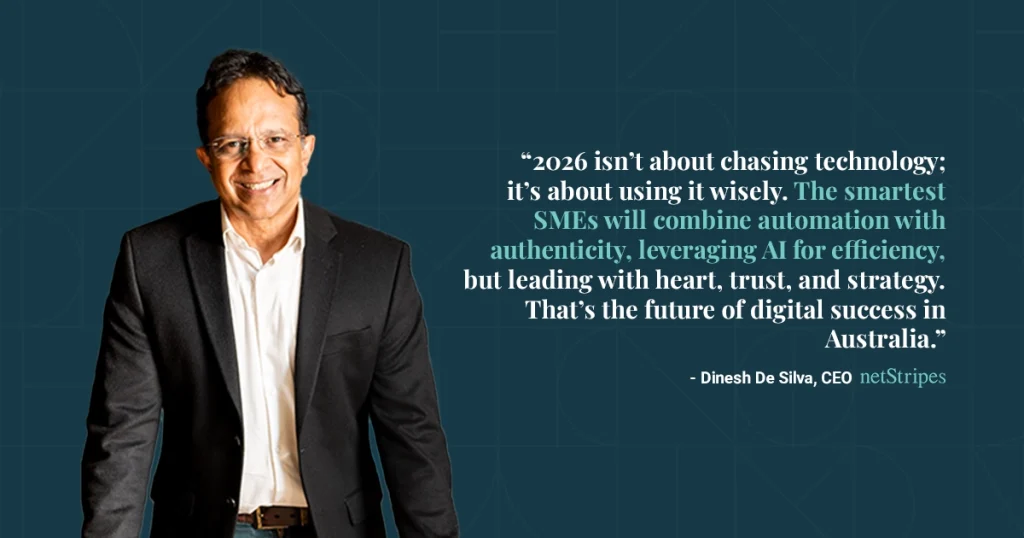
Featuring insights from Dinesh De Silva, CEO, NetStripes

From smarter AI tools to new ways of connecting with customers, technology is reshaping how small and medium businesses grow, market, and operate. The good news? You don’t need a massive budget to stay ahead of the digital trends 2026.

Most of these innovations that are reshaping the business world in 2026 are accessible and affordable, enabling small and medium-sized businesses to harness enterprise-level technology.

Here’s our guide to the 10 Digital Trends that matter most in 2026 and how you can apply them to gain an edge.

1. AI Assistants & Everyday Automation

Digital Trends 2026 AI

AI has officially become part of everyday business. By 2026, smart assistants will be doing much more than writing text; they’ll be managing schedules, qualifying leads, replying to emails, and even running parts of your business while you sleep.

Tools like ChatGPT Teams, Fyxer AI, HubSpot AI, n8n, and Zapier Agents are making automation easier and more affordable than ever.

Pro tip: Choose one repetitive task, such as appointment scheduling or customer follow-ups, and automate it. Once you see the time savings, you’ll be hooked.

2. Smarter Dashboards & Connected Tools

Digital Trends 2026 - dashboards

If you’re tired of juggling spreadsheets and tabs, you’ll love this trend. In 2026, more small businesses are connecting their website, socials, email, and ad platforms into one simple dashboard.

Tools like Looker Studio, Metricool, or Databox show you what’s working in real time, so you can make quick, confident decisions without having to refer to multiple sheets or tabs.

Pro tip: Start by linking your Google Analytics, Meta Ads, and CRM data into one dashboard. You’ll spot insights you’ve never seen before.

3. Generative AI: Fast, Creative, Affordable

Digital Trends 2026 - Gen AI

Generative AI is changing the way brands create ads, blogs, videos, and even customer testimonials. You no longer need a big marketing team to create great content. 

With Canva Magic Studio, Adobe Firefly, and ChatGPT, you can design visuals, write posts, and draft videos in minutes, all while keeping your unique style intact.

The most important thing is to keep your brand’s personality clear. AI can do much of the work, but your personal touch still makes content feel authentic and relatable.

Pro tip: Use AI for the first draft, then polish it with your personal touch. You’ll create faster and still sound like you.

4. Personalisation That Feels Human

Digital Trends 2026 - brands personalization

Customers expect more than generic messages. In 2026, personalisation means delivering the right message at the right time, without needing a big data team.

Nowadays, smart CRMs, social ad platforms, and eCommerce tools analyse real-time data to recommend products, predict needs, and deliver the right message at the right time.

AI-driven platforms like Mailchimp, ActiveCampaign, Shopify, and Meta Ads make this simple by analysing customer behaviour and suggesting what to say next.

Action tip: Try one personalised campaign, such as product recommendations or location-based offers. Measure how much better it performs than your usual emails.

5. Human Brands Win

Digital Trends 2026 - human brands

In a world that is dominated by automation and AI, authenticity has become your biggest competitive edge. 

Online consumers still crave a ‘’human touch’’ and want to know who they’re buying from. Your story, your values, and your passion all matter when it comes to selling your products or services.

By showing up as you, you create trust, relatability, and loyalty that no algorithm can replicate.

Pro tip: Create short videos or posts that share the story behind your business; why you started, what drives you, or even a glimpse of your team in action. Let your audience see the real faces and emotions behind the brand.

“Your greatest strength in the age of AI is still you.”

6. Strategy Before Software

Digital Trends 2026 - strategy before software

Before jumping into new tools or digital trends 2026, start with a clear digital strategy. Too many businesses are pouring money into websites, ads, or AI subscriptions without a clear direction and then end up wondering why the results fall short.

A strong digital strategy gives every action meaning. It connects your goals, audience, and resources so each decision moves your business forward with a purpose.

That’s where tools like netStripes’ Xell.ai come in handy, helping you refine your business strategy by identifying your strengths and uncovering opportunities before you invest.

Pro tip: Define your target audience, goals, and how you’ll measure success. When your strategy is prioritised, every tool you add works harder for you.

7. Customer Experience Is the New Marketing

Digital Trends 2026  - customer experience in marketing

Every click, email, and interaction shapes how customers perceive your business. In today’s hyper-connected world, marketing isn’t just about what you say; it’s about how people feel every time they engage with you.

The businesses winning in digital trends 2026 are those using digital tools to deliver seamless, stress-free experiences. That means faster responses, easier bookings, consistent communication, and proactive support, the kind that makes customers say, “That was simple.”

When your customer experience is smooth and reliable, it becomes your most powerful marketing tool, driving word-of-mouth, loyalty, and repeat sales automatically.

Action tip: Map your customer journey. Look for one area that causes friction (like response time or booking ease) and fix it with automation or AI.

Digital Trends 2026 - Conversational & Visual Search

People are no longer typing keywords, they’re asking questions and showing pictures.
AI-driven search tools like ChatGPT Search and Google’s AI Overviews are changing how customers find businesses.

Now, people ask questions like ‘Where can I find a family accountant near Parramatta?’ and AI tools respond with one or two top answers instead of a long list of links.

To stay discoverable, businesses need to optimise content for conversational and visual queries. That means writing in natural language, using structured data, and including clear visuals or videos where possible.

Pro tip: Update your website FAQ and blog sections to answer common customer questions directly. This format is more likely to be picked up by AI search engines and featured in conversational results.

9. Build Your Own Audience

Digital Trends 2026 - audience building

Social media is powerful, but it’s rented space. Algorithms shift, reach drops, and one policy change can make your audience disappear overnight.

The most successful business owners in 2026 are focusing on building their own micro-communities.

By building your own audience through newsletters, private groups, or membership content, you gain control over how and when you connect with customers. It’s not just about followers anymore, it’s about relationships that last beyond the feed.

When you create a direct line of communication, you can share valuable insights, announce new offers, and build loyalty without depending on social media platforms to do the work.

Action tip: Turn your best social content into a monthly email or private online group. It’s your space, not the algorithm’s.

10. Keep Learning, Always

Digital Trends 2026-Learning

Technology won’t slow down, and neither should you. The businesses that thrive in 2026 aren’t necessarily the biggest; they’re the ones that stay curious and keep adapting.

When learning becomes part of your company culture, innovation follows. Whether it’s exploring new digital tools, attending webinars, or encouraging your team to upskill, continuous learning keeps your business agile, competitive, and future-ready.

Action tip: Block an hour or two in your calendar each month to explore a new tool or digital trends 2026 on your own or as a team. Curiosity compounds over time.

Where to Begin

  1. Automate one task with AI.
  2. Connect your digital tools into a single view.
  3. Personalise your customer experience.
  4. Share your story online.
  5. Keep learning and improving every month.

You don’t need to do it all at once, just start slow, stay curious, and focus on progress, not perfection.

Digital Trends 2026 - Dinesh De Silva netstripes

Conclusion

2026 isn’t about chasing technology for technology’s sake.  It’s about using it wisely to save time, serve customers better, and grow your business with confidence with these top digital trends.

At netStripes, we believe innovation should always be practical, affordable, and human-centred, empowering business owners to do more, with less, while staying true to who they are.

To find out more about how you can apply these digital trends to your business, book a FREE digital advisory session with our digital strategists.

Australia’s SMEs at Crossroads: The Small Business Playbook for 2026

CPA Australia’s latest data reveals a widening gap between digital leaders and laggards, and outlines what SMEs can do about it.

Quick Snapshot

If you only have two minutes, here’s what you need to know:

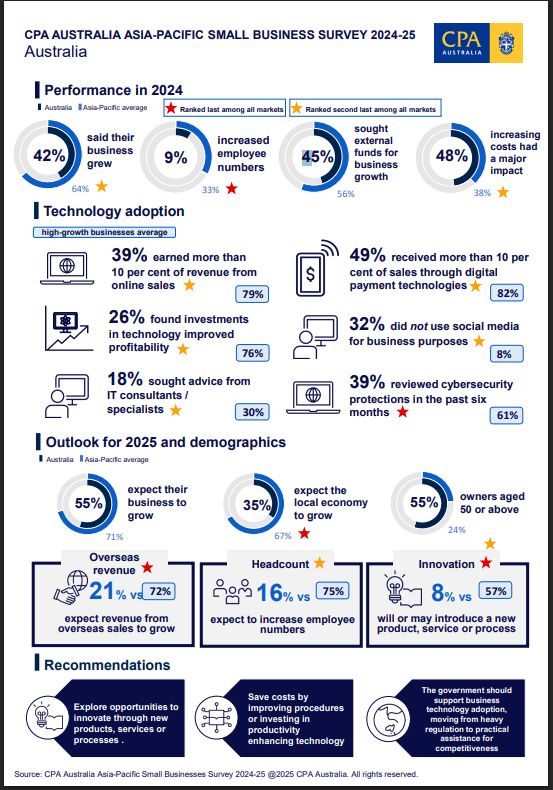
  • Only 42% of Australian SMEs grew in 2024 — well below the Asia-Pacific average of 64%.
  • While 74% Asia Pacific businesses plan to expand headcount in 2025, only 16% of Australian businesses will.
  • Just 39% earn more than 10% of their revenue online.
  • Growth expectations for 2025 rise slightly to 55%, but remain below those of regional peers.
  • Young leaders (under 40) and firms with 5–19 employees are the most likely to grow.
  • Businesses that invest in strategy, digital presence, and funding for innovation outperform others.

Bottom line: SMEs that lead with a clear strategy and digital capability will dominate 2025. The rest will struggle for visibility in an AI-driven marketplace.

The State of Australian SMEs in 2025

The CPA Australia 2024-25 Asia-Pacific Small Business Survey paints a clear picture: many Australian small businesses are cautious, even as opportunity expands globally.

While regional peers accelerate digital transformation, Australian SMEs risk being left behind due to slower adoption of e-commerce, underinvestment in marketing technology, and hesitation around growth funding.

At netStripes, we see this not as bad news, but as a wake-up call. It highlights exactly where strategic and digital innovation can make the biggest difference.

1. The Growth Gap

  • Only 42% of SMEs reported growth in 2024 versus 64% regionally.
  • Only 16% expected to hire vs 74%
  • Just 55% expect growth in 2025.
  • The top performers share common traits — they plan, measure, and act on digital opportunities.

Pro Tip: Review your 2024 metrics. If your revenue hasn’t grown by at least 10%, treat 2025 as your digital transformation year. Set tangible quarterly targets for leads, conversion, and online revenue.

2. The Digital Opportunity

Only 39% of Australian SMEs earn more than 10% of their revenue online. In contrast, in Singapore and mainland China, the majority exceed that benchmark.

Digital revenue is no longer just an extra stream — it’s the foundation of competitiveness. SMEs with high-conversion websites, clear strategy, and strong digital marketing outperform in visibility, trust, and sales conversion.

Pro Tip: Aim for 20–30% of total revenue to come from online channels by the end of 2025. Start with a website conversion audit and a strategic content plan aligned to your buyer’s journey.

3. Marketing and Technology Investment: Mind the ROI

Australian SMEs acknowledge the value of Marketing and technology, but fewer see real returns. This suggests many are investing without clear alignment to business outcomes.

At netStripes, we find that ROI comes when:

  • Tech and marketing investment is tied to clear goals.
  • Owners and Teams have a clear road map/ strategy and are trained to use the tools that deliver. 
  • Results are about a best practice process, takes multiple skill sets and a patient data-driven approach until lead flow is established for each business.
  • Establishing lead flow is about problem-solving until achievement, and it differs for every business. 
  • Data is reviewed regularly and acted upon.

Pro Tip: Don’t simply chase leads or silver bullets — establish best practice marketing processes, analysis of data, and a team that problem-solves until consistent repeatable lead flow is established. Patience is key.

4. Business Demographics and Growth Potential

CPA Australia’s data shows:

  • Younger leaders (under 40) and businesses aged 5–10 years are more likely to grow.
  • Firms with 5–19 employees perform best, balancing agility with resources.

This isn’t just demographic luck, it’s a mindset. These businesses are typically proactive, data-driven, and growth-oriented.

Pro Tip: No matter your age or business stage, you can emulate this mindset by setting measurable growth goals, adopting a learning culture, and reviewing strategy quarterly.

5. Access to Finance: The Growth Enabler

Businesses that grow are twice as likely to use external finance to fund innovation, marketing, and technology. This suggests that leveraging finance strategically rather than avoiding it, can accelerate growth.

Pro Tip: Prepare a Growth Funding Blueprint before approaching lenders. Detail how funding will generate returns — through business assets, digital marketing, automation, or website redevelopment.

Conclusion: 2026 The Year to Lead, Not Lag

The CPA Australia data shows a clear truth: growth is no longer a function of size, but of strategy.

SMEs that align their business goals with a powerful online presence, a data-driven marketing plan, and the right technology will lead their industries.

At netStripes, we’ve seen it time and again — when small businesses adopt clarity, strategy, and innovation, they don’t just grow; they transform.

2026 is your year to lead. Take charge with a strategy that’s grounded in data and executed with purpose. Because business leadership today begins and scales online.

CPA Australia’s latest data

source: www.cpaaustralia.com.au